Building Robust APIs: A Deep Dive into Idempotency Keys and Design Patterns
Idempotency is critical for building resilient APIs that can handle retries and network failures without unintended side effects. This post explores why it's essential and how to implement it effectively using idempotency keys.
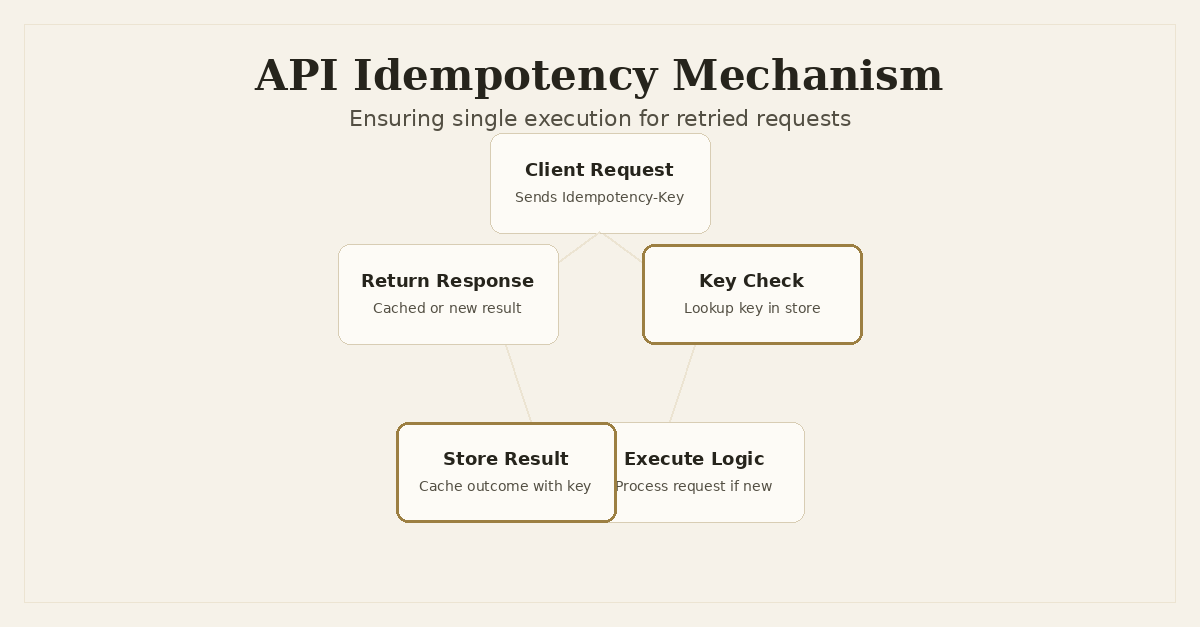
Building Robust APIs: A Deep Dive into Idempotency Keys and Design Patterns
Modern distributed systems are complex. Network glitches happen. Servers go down, even if briefly. Clients time out. When these inevitable failures occur, a well-designed API needs to handle retries gracefully. If it doesn't, a simple retry from a client could lead to unintended, and potentially disastrous, side effects like duplicate payments, multiple order creations, or inconsistent data.
This is where the concept of idempotency becomes crucial. It's a fundamental principle in API design that, when applied correctly, significantly enhances the reliability and fault tolerance of your services.
What is Idempotency?
In mathematics, an operation is idempotent if applying it multiple times produces the same result as applying it once. Think about multiplying a number by 1, or taking the absolute value of a positive number – repeating these operations doesn't change the outcome.
In the context of APIs, an idempotent operation guarantees that sending the same request multiple times will have the exact same effect on the server's state as sending it once. It's not about returning the same response every time (though often it does), but about ensuring the side effects on the server are identical.
Let's break down why this matters for different HTTP methods:
- GET: Naturally idempotent. Retrieving data multiple times doesn't change anything on the server.
- PUT: Naturally idempotent. Updating a resource with the same data multiple times results in the resource being in the same final state. Creating a resource via PUT (if the client specifies the ID) is also idempotent.
- DELETE: Naturally idempotent. Deleting a resource multiple times results in the resource being absent. The first successful deletion removes it; subsequent deletions simply confirm its absence.
- POST: Not inherently idempotent. A POST request is typically used to create a new resource. Retrying a
POST /ordersrequest, for example, could lead to multiple orders being created, which is almost certainly not what you want.
This distinction is key. While GET, PUT, and DELETE handle retries gracefully by design, POST requests require explicit handling to achieve idempotency at the application level.
The Problem: When Retries Go Wrong
Imagine a payment processing API. A client sends a POST /payments request to charge a user. Here's a typical sequence of events:
- Client sends request to
POST /payments. - Server processes the payment successfully with the payment gateway.
- Server attempts to send a
200 OKresponse back to the client. - Network failure occurs. The response never reaches the client.
- Client, not having received a response, assumes the request failed and retries the
POST /paymentsrequest.
Without idempotency, this retry would lead to a second, identical payment being processed, double-charging the user. This is a severe bug, impacting user trust and requiring complex reconciliation processes.
Similar issues arise with:
- Order Creation:
POST /ordersmight create multiple identical orders. - User Registration:
POST /userscould register the same user multiple times or attempt to, leading to unique constraint errors or unexpected data. - Fund Transfers:
POST /transferscould move money multiple times.
These scenarios highlight the critical need for a mechanism to ensure that even if a request is received multiple times, its side effects are only applied once.
The Solution: Idempotency Keys
The most common and effective way to achieve application-level idempotency for non-idempotent HTTP methods (like POST) is through the use of idempotency keys.
An idempotency key is a unique, client-generated identifier that accompanies a request. When the server receives a request with an idempotency key, it uses this key to track whether it has already processed a request with the same key. If it has, it simply returns the result of the original processing instead of executing the operation again.
How Idempotency Keys Work
The basic flow for an idempotent POST request using an idempotency key looks like this:
- Client Generates Key: Before sending the request, the client generates a unique identifier (e.g., a UUID v4) for that specific request. This key is often sent in a custom HTTP header, like
Idempotency-Key. - Server Receives Request: The server receives the request, extracts the
Idempotency-Key. - Key Lookup: The server checks its idempotency store (a database table or cache) to see if this key has been seen before.
- First Time Processing: If the key is not found:
- The server marks the key as 'processing' in its store.
- It executes the core business logic (e.g., create order, process payment).
- Upon successful completion, it stores the request's outcome (status code, response body) associated with the idempotency key.
- It returns the response to the client.
- Subsequent Request (Retry): If the key is found:
- If processing is complete: The server retrieves the stored result associated with the key and returns it immediately, without re-executing the business logic.
- If processing is ongoing: The server might return a
409 Conflict(indicating another request with the same key is active), a202 Accepted(indicating processing is underway), or block until the original request completes and then return its result. The blocking approach is often preferred for simplicity from the client's perspective, but requires careful implementation to avoid deadlocks or excessive wait times.
Design Considerations for Idempotency Keys
1. Key Generation
Clients should generate robust, globally unique identifiers. UUIDs (Universally Unique Identifiers), specifically UUIDv4, are excellent choices because they are highly unlikely to collide. The client should generate a new key for each new logical request, but reuse the same key for any retries of that specific logical request.
# Client-side example for generating an idempotency key
import uuid

def send_idempotent_request(url: str, payload: dict, idempotency_key: str = None):
    if idempotency_key is None:
        idempotency_key = str(uuid.uuid4()) # Generate a new key for a new logical request

    headers = {'Content-Type': 'application/json', 'Idempotency-Key': idempotency_key}
    # In a real app, you'd use requests.post or similar, and handle retries
    # with the same idempotency_key if the first attempt fails.
    print(f"Sending request to {url} with Idempotency-Key: {idempotency_key}")
    # Simulate network request
    # response = requests.post(url, json=payload, headers=headers)
    # return response, idempotency_key
    pass

# Example usage:
# first_attempt_key = None
# response, first_attempt_key = send_idempotent_request('/payments', {'amount': 100}, first_attempt_key)
# if response.status_code != 200:
#     # Retry with the same key
#     response, _ = send_idempotent_request('/payments', {'amount': 100}, first_attempt_key)
2. Key Storage
The idempotency store needs to be fast and reliable. Common choices include:
- Database Table: A dedicated table
idempotency_keysstoring thekey,request_hash(to ensure the request body hasn't changed),response_status,response_body,created_at, andexpires_at. This provides persistence and transactional consistency. It's good for critical operations where you need to audit past requests. - Redis/Memcached: A high-performance in-memory key-value store. This is faster for lookups but is typically volatile. You'd store the key, a status (processing/completed), and the response. Requires careful handling of persistence if the cache restarts.
For most critical applications, a database table is a safer bet, potentially fronted by a cache for hot keys to reduce database load.
3. Handling Concurrent Requests
What happens if two clients (or a client retrying very quickly) send requests with the same idempotency key simultaneously? You need a mechanism to ensure only one proceeds.
- Database Unique Constraint: A unique constraint on the
Idempotency-Keycolumn in your database table is critical. The first request to insert the key will succeed; subsequent concurrent inserts will fail, preventing duplicate processing. - Atomic Operations: When updating the state of an idempotency key (e.g., from 'pending' to 'completed'), use atomic database operations (
UPDATE ... WHERE ... AND status = 'pending'). - Locking/Semaphores (for cache-based stores): If using Redis, you might use a distributed lock (e.g., Redlock) around the key lookup and processing logic to ensure only one worker processes a given key at a time. This adds complexity.
4. Key Expiration
Idempotency keys should not live forever. After a certain period (e.g., 24 hours, 7 days), it's safe to assume that any potential retries for a specific logical request would have already occurred. Expiring old keys prevents the idempotency store from growing indefinitely and consuming excessive resources. You can use TTLs in Redis or a scheduled cleanup job for database tables.
Implementing Idempotency in FastAPI (with SQLAlchemy)
Let's walk through a practical example using FastAPI and SQLAlchemy. We'll create a simple endpoint for creating an item, making it idempotent.
First, define your SQLAlchemy models:
# models.py
from datetime import datetime, timedelta
from typing import Optional
from sqlalchemy import create_engine, Column, String, Integer, DateTime, Text, Boolean
from sqlalchemy.orm import sessionmaker, declarative_base

DATABASE_URL = "sqlite:///./sql_app.db" # Use a real DB in production

engine = create_engine(DATABASE_URL, connect_args={"check_same_thread": False})
SessionLocal = sessionmaker(autocommit=False, autoflush=False, bind=engine)
Base = declarative_base()

class Item(Base):
    __tablename__ = "items"
    id: int = Column(Integer, primary_key=True, index=True)
    name: str = Column(String, index=True)
    description: Optional[str] = Column(String, default=None)

class IdempotencyKey(Base):
    __tablename__ = "idempotency_keys"
    key: str = Column(String, primary_key=True, index=True)
    request_hash: str = Column(String, index=True, nullable=False) # Hash of request body + path
    response_status: int = Column(Integer, nullable=True)
    response_body: str = Column(Text, nullable=True)
    created_at: datetime = Column(DateTime, default=datetime.utcnow)
    expires_at: datetime = Column(DateTime, nullable=False)
    locked_until: Optional[datetime] = Column(DateTime, default=None) # For concurrent request handling
    is_completed: bool = Column(Boolean, default=False)

# Create tables
Base.metadata.create_all(bind=engine)
Next, we need a dependency to get a database session and a utility to generate a request hash. The request hash is important: it ensures that the client isn't using the same idempotency key for different requests (e.g., creating item A then item B with the same key).
# dependencies.py
import hashlib
import json
from datetime import datetime, timedelta
from typing import Generator

from fastapi import Request, HTTPException, status
from sqlalchemy.orm import Session
from sqlalchemy.exc import IntegrityError
from .models import SessionLocal, IdempotencyKey

def get_db() -> Generator[Session, None, None]:
    db = SessionLocal()
    try:
        yield db
    finally:
        db.close()

def generate_request_hash(request: Request, body: bytes) -> str:
    """Generates a hash of the request path and body."""
    # Ensure consistent ordering for JSON body hashing
    try:
        json_body = json.loads(body.decode('utf-8'))
        # Sorting keys ensures consistent hash regardless of order
        sorted_body = json.dumps(json_body, sort_keys=True, separators=(',', ':')).encode('utf-8')
    except json.JSONDecodeError:
        sorted_body = body # Not JSON, hash raw body

    hasher = hashlib.sha256()
    hasher.update(request.url.path.encode('utf-8'))
    hasher.update(sorted_body)
    return hasher.hexdigest()
Now, let's create a custom FastAPI dependency or middleware to handle idempotency. A dependency is often cleaner for specific endpoints.
# idempotency.py
from datetime import datetime, timedelta
from typing import Callable, Optional
import json
from functools import wraps

from fastapi import Request, Response, HTTPException, status, Depends
from sqlalchemy.orm import Session
from sqlalchemy.exc import IntegrityError
from starlette.background import BackgroundTask

from .models import IdempotencyKey
from .dependencies import get_db, generate_request_hash

IDEMPOTENCY_EXPIRATION_SECONDS = 60 * 60 * 24 # 24 hours

async def process_idempotent_request(
    request: Request,
    db: Session = Depends(get_db)
):
    idempotency_key = request.headers.get('Idempotency-Key')
    if not idempotency_key:
        return # Not an idempotent request, proceed normally

    # Read body once for hashing and potential future use
    request_body_bytes = await request.body()
    request_hash = generate_request_hash(request, request_body_bytes)

    # Check for existing key
    existing_key_record = db.query(IdempotencyKey).filter(IdempotencyKey.key == idempotency_key).first()

    if existing_key_record:
        # 1. Key found, check request hash
        if existing_key_record.request_hash != request_hash:
            raise HTTPException(
                status_code=status.HTTP_400_BAD_REQUEST,
                detail=f"Idempotency-Key '{idempotency_key}' used with a different request body or path."
            )

        # 2. Key found, check if completed
        if existing_key_record.is_completed:
            # Return cached response
            return Response(
                content=existing_key_record.response_body,
                status_code=existing_key_record.response_status,
                media_type='application/json' # Assuming JSON responses
            )

        # 3. Key found, but processing is ongoing (or failed to complete)
        # We need to handle concurrent requests attempting to use the same key.
        # For simplicity, we'll make concurrent requests wait briefly or return 409.
        # A more advanced approach might involve a distributed lock or polling.

        # Check if it's locked and still valid
        if existing_key_record.locked_until and existing_key_record.locked_until > datetime.utcnow():
            # Still locked by another process or previous attempt that timed out
            # For simplicity, we'll return a 409. In a real system, you might
            # implement a short busy-wait or poll.
            raise HTTPException(
                status_code=status.HTTP_409_CONFLICT,
                detail="A request with this idempotency key is already being processed."
            )
        else:
            # Lock expired or not locked, attempt to acquire lock
            # This is a critical section: we need to ensure only one process
            # updates the lock. This is simplified for a single-server setup.
            # For distributed, you'd need a distributed lock (e.g., Redis based).
            try:
                # Optimistic locking: update only if not already locked
                db.query(IdempotencyKey).filter(
                    IdempotencyKey.key == idempotency_key,
                    (IdempotencyKey.locked_until <= datetime.utcnow()) | (IdempotencyKey.locked_until == None)
                ).update(
                    {IdempotencyKey.locked_until: datetime.utcnow() + timedelta(seconds=30)}, # Lock for 30 seconds
                    synchronize_session=False
                )
                db.commit()
                # If update successful, this process has the lock. Proceed as new request.
            except Exception:
                db.rollback()
                raise HTTPException(
                    status_code=status.HTTP_409_CONFLICT,
                    detail="Failed to acquire lock for idempotency key. Another process might be active."
                )

    else: # Key not found, this is a new request
        # Create a new idempotency key record and mark as locked/processing
        new_key_record = IdempotencyKey(
            key=idempotency_key,
            request_hash=request_hash,
            created_at=datetime.utcnow(),
            expires_at=datetime.utcnow() + timedelta(seconds=IDEMPOTENCY_EXPIRATION_SECONDS),
            locked_until=datetime.utcnow() + timedelta(seconds=30), # Initial lock for processing
            is_completed=False
        )
        try:
            db.add(new_key_record)
            db.commit()
            db.refresh(new_key_record) # Ensure we have the latest state
        except IntegrityError:
            db.rollback()
            # This can happen if two concurrent requests try to insert the same key
            # In this case, another request won the race. Treat as a conflict.
            raise HTTPException(
                status_code=status.HTTP_409_CONFLICT,
                detail="Idempotency key collision detected. Another request is processing."
            )
        except Exception as e:
            db.rollback()
            raise HTTPException(
                status_code=status.HTTP_500_INTERNAL_SERVER_ERROR,
                detail=f"Error creating idempotency key record: {e}"
            )

    # Attach the idempotency key record to the request state for later use
    request.state.idempotency_key_record = db.query(IdempotencyKey).filter(IdempotencyKey.key == idempotency_key).first()
    request.state.idempotency_processing_started = True

# Decorator to apply idempotency handling to an endpoint
def idempotent(func: Callable) -> Callable:
    @wraps(func)
    async def wrapper(request: Request, db: Session = Depends(get_db), *args, **kwargs):
        idempotency_key = request.headers.get('Idempotency-Key')
        if not idempotency_key:
            return await func(request, db, *args, **kwargs)

        # Pre-processing (check key, acquire lock if new)
        pre_process_response = await process_idempotent_request(request, db)
        if pre_process_response:
            return pre_process_response # Return cached response or conflict

        # If we reach here, it means we are the 'winning' request to process
        # The request.state.idempotency_key_record should be set by process_idempotent_request
        idempotency_record = request.state.idempotency_key_record

        # Execute original endpoint logic
        response = await func(request, db, *args, **kwargs)

        # Post-processing (store result)
        if idempotency_record and request.state.idempotency_processing_started:
            try:
                # Ensure response body is read and stored
                response_body_bytes = b''
                if isinstance(response, Response):
                    async for chunk in response.body_iterator:
                        response_body_bytes += chunk
                    # Reconstruct response if it was consumed
                    response = Response(content=response_body_bytes, status_code=response.status_code, media_type=response.media_type)
                elif hasattr(response, 'body'): # For JSONResponse, etc.
                    response_body_bytes = response.body

                idempotency_record.response_status = response.status_code
                idempotency_record.response_body = response_body_bytes.decode('utf-8')
                idempotency_record.is_completed = True
                idempotency_record.locked_until = None # Release lock
                db.add(idempotency_record)
                db.commit()
            except Exception as e:
                db.rollback()
                # Log this error. The request might have completed, but we failed to store its state.
                # This means a retry could re-process it. This is a critical failure.
                print(f"CRITICAL: Failed to store idempotency result for key {idempotency_key}: {e}")

        return response
    return wrapper
And finally, the FastAPI application:
# main.py
from fastapi import FastAPI, Depends, Request, HTTPException, status, Response
from pydantic import BaseModel
from sqlalchemy.orm import Session
from .models import Item, SessionLocal
from .dependencies import get_db
from .idempotency import idempotent

app = FastAPI()

class ItemCreate(BaseModel):
    name: str
    description: Optional[str] = None

class ItemResponse(BaseModel):
    id: int
    name: str
    description: Optional[str] = None

    class Config:
        orm_mode = True

@app.post("/items/", response_model=ItemResponse)
@idempotent
async def create_item(item: ItemCreate, db: Session = Depends(get_db)):
    """
    Creates a new item. This endpoint is made idempotent using the @idempotent decorator.
    A client can send an 'Idempotency-Key' header to ensure duplicate requests
    do not create duplicate items.
    """
    # Simulate a time-consuming operation (e.g., calling an external service)
    # This is where the actual business logic resides.
    import asyncio
    await asyncio.sleep(2) # Simulate external API call or heavy computation

    db_item = Item(name=item.name, description=item.description)
    db.add(db_item)
    db.commit()
    db.refresh(db_item)
    return db_item

@app.get("/items/{item_id}", response_model=ItemResponse)
def read_item(item_id: int, db: Session = Depends(get_db)):
    item = db.query(Item).filter(Item.id == item_id).first()
    if not item:
        raise HTTPException(status_code=404, detail="Item not found")
    return item

@app.on_event("startup")
def on_startup():
    # Ensure tables are created when the app starts
    from .models import Base, engine
    Base.metadata.create_all(bind=engine)
This implementation provides a robust framework for idempotency:
- Client-generated keys: The client controls the idempotency scope.
- Request hashing: Prevents using the same key for different logical requests.
- Database storage: Provides persistence and transactional integrity for idempotency records.
- Concurrent request handling: Uses
locked_untilandIntegrityErrorto manage race conditions. - Response caching: Returns the original response for retries, saving computation.
- Decorator pattern: Keeps endpoint logic clean and focused on business rules.
Considerations and Trade-offs
Implementing idempotency, especially with a robust mechanism like idempotency keys, comes with its own set of trade-offs and considerations:
- Performance Overhead: Each idempotent request involves at least one database or cache lookup (to check the key) and potentially another write (to store the result). For extremely high-throughput APIs where every millisecond counts, this overhead needs to be benchmarked. Often, the reliability gains outweigh this slight performance hit.
- Storage Management: The idempotency store can grow large. Regularly cleaning up expired keys is essential. You might implement a background cron job to delete records older than the
expires_attimestamp. - Consistency vs. Availability: When a client retries a request and the server finds the key marked as 'processing', how do you respond? Returning
409 Conflictprioritizes consistency (no duplicate processing) but might require the client to implement a retry-with-delay strategy. Blocking until completion prioritizes availability (eventual success for the client) but adds complexity to the server-side and potential for long-lived connections. - Error Handling: If the original request fails after the idempotency key is marked as 'processing' but before the result is stored, a retry might still see the key as 'processing' or 'locked'. Your system needs a strategy to detect and potentially clear such stuck states (e.g.,
locked_untiltimestamps with reasonable timeouts). For critical operations, robust logging and monitoring are key. - Client Responsibility: Clients must generate unique keys for each new logical request and reuse the same key for retries of that specific request. Clear API documentation is vital here.
- Granularity: Decide the scope of idempotency. Is it per API call, or does it span a broader business transaction? For complex workflows, idempotency keys might be applied at a higher level, coordinating multiple API calls.
- Distributed Transactions: While idempotency helps with retries of a single operation, it doesn't solve the problem of distributed transactions (e.g., coordinating updates across multiple microservices or databases). For those, patterns like the Saga pattern or two-phase commit might be necessary, often in addition to idempotency at each service boundary.
Conclusion
Idempotency is not just a nice-to-have; it's a fundamental requirement for building reliable and fault-tolerant APIs in a distributed environment. By implementing idempotency keys, you empower your services to handle network unreliability and client retries gracefully, preventing data corruption and ensuring consistent state.
The initial effort to design and implement idempotency pays dividends in reduced debugging time, improved data integrity, and a better experience for your API consumers. It's a hallmark of a robust, production-ready backend system. While the specific implementation details will vary based on your tech stack and requirements, the core principles of unique keys, persistent storage, and careful state management remain constant.
Frequently Asked Questions
What is API idempotency?
API idempotency means that making the same request multiple times will have the same effect as making it once. It's crucial for handling network retries without creating duplicate resources or unintended side effects.
Why are idempotency keys important for POST requests?
While HTTP methods like GET, PUT, and DELETE are inherently idempotent, POST requests are not. Idempotency keys provide an application-level mechanism to make POST requests idempotent, preventing duplicate resource creation on retries.
Where should idempotency keys and their results be stored?
Idempotency keys and their corresponding request results can be stored in a database (e.g., a dedicated table for idempotency records) or a high-performance cache like Redis. The choice depends on factors like persistence requirements, performance needs, and consistency.
How do you handle concurrent requests with the same idempotency key?
When multiple requests with the same idempotency key arrive concurrently, the server should process only the first one and make subsequent requests either wait for the initial processing to complete or return an immediate 'conflict' (409) or 'processing' (202) status, depending on the desired behavior.
Written by Ansh Gautam
Full-stack engineer building production systems with FastAPI, React, and AI/LLM integrations. Currently looking for backend engineering & AI integration roles.