Load Balancing Algorithms: Beyond Round Robin
Distributing traffic efficiently is critical for any scalable system. This post dives into various load balancing algorithms, from basic round robin to more sophisticated strategies like least connections and IP hash, and their real-world implications.
Load Balancing Algorithms: Beyond Round Robin
Building scalable and resilient systems is a core part of backend engineering. Whether I'm orchestrating requests across dozens of LLM providers with something like the Dronzer AI Gateway or managing hundreds of concurrent WebSocket connections for a real-time attendance system, the ability to distribute incoming traffic efficiently is paramount. Just throwing more servers at a problem rarely solves it if you're not smart about how you route requests to them. This is where load balancing comes in.
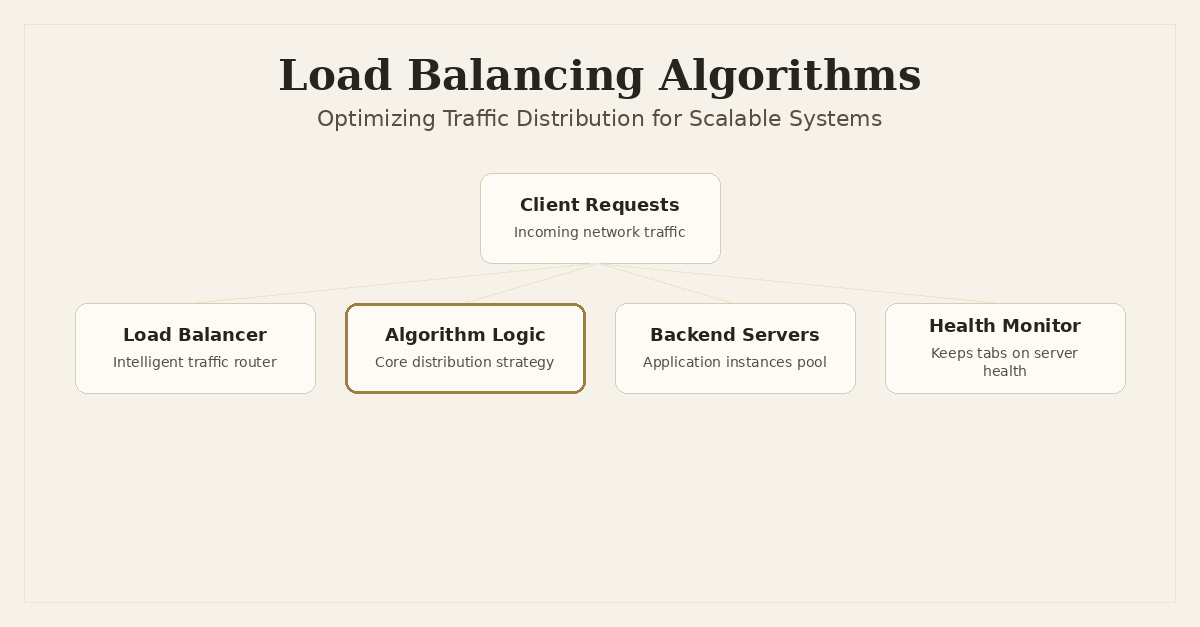
At its simplest, a load balancer acts as a traffic cop, sitting in front of your server pool and directing client requests to individual backend instances. The goal is straightforward: maximize throughput, minimize response time, avoid overloading any single server, and ensure high availability by transparently routing around unhealthy instances. But the devil, as always, is in the details of how that traffic is distributed.
The Fundamental Challenge of Traffic Distribution
Imagine you have a popular web service. As user demand grows, a single server can't handle it anymore. You add more servers. Now, how do you decide which server gets the next request? If you just pick one at random, or always send to the first available, you'll quickly run into issues:
- Uneven Load: Some servers become overloaded while others sit idle or underutilized.
- Performance Bottlenecks: Requests routed to an overloaded server experience high latency or even timeouts, even if other servers are perfectly capable.
- Lack of Resilience: If a server goes down, requests might still be sent to it, leading to errors and service disruption.
Load balancing algorithms address these challenges by providing structured, intelligent ways to distribute the workload. Let's start with the most basic and then move into more sophisticated approaches.
Round Robin: The Simplest Approach
Round Robin is the easiest load balancing algorithm to understand and implement. It distributes client requests to servers in a sequential, rotating manner. The first request goes to server 1, the second to server 2, the third to server 3, and so on. Once it reaches the last server, it loops back to server 1.
Pros:
- Simplicity: Trivial to implement and configure.
- Even Distribution (in theory): Over a long period, if all requests are identical in processing cost, each server receives an equal number of requests.
Cons:
- Ignores Server Load/Capacity: This is the biggest drawback. Round Robin doesn't care if server 1 is bogged down with a complex database query or if server 3 just started up and is still warming its cache. It just sends the next request in line. This can lead to uneven load and performance degradation if backend servers have varying capacities or are processing tasks of different computational intensity. For a system like the real-time attendance manager, where some requests might trigger heavy data processing and others are simple pings, this could quickly lead to bottlenecks.
Nginx Configuration Example (Round Robin)
Nginx, a powerful web server and reverse proxy, makes configuring load balancing straightforward. Here's a basic upstream block for Round Robin:
# /etc/nginx/nginx.conf or a site-specific config file

upstream backend_servers {
    server 192.168.1.101;
    server 192.168.1.102;
    server 192.168.1.103;
}

server {
    listen 80;

    location / {
        proxy_pass http://backend_servers;
        proxy_set_header Host $host;
        proxy_set_header X-Real-IP $remote_addr;
        proxy_set_header X-Forwarded-For $proxy_add_x_forwarded_for;
    }
}
By default, Nginx uses Round Robin when no specific load balancing method is defined in the upstream block.
Weighted Round Robin: Accounting for Capacity
Weighted Round Robin is an enhancement to the basic Round Robin algorithm. It allows you to assign a weight to each server, indicating its processing capacity relative to others. Servers with higher weights receive a proportionally larger share of requests.
Use Cases:
- Heterogeneous Servers: When you have servers with different hardware specifications (e.g., some with more RAM or faster CPUs).
- Gradual Rollouts: During deployments, you might want to send only a small percentage of traffic to a new server, increasing its weight as confidence grows.
- Maintenance: Temporarily reduce a server's weight before taking it offline for maintenance.
Nginx Configuration Example (Weighted Round Robin)
upstream backend_servers_weighted {
    server 192.168.1.101 weight=3; # Receives 3x more traffic
    server 192.168.1.102 weight=1;
    server 192.168.1.103 weight=1;
}

server {
    listen 80;

    location /weighted {
        proxy_pass http://backend_servers_weighted;
        # ... other proxy headers ...
    }
}
In this setup, 192.168.1.101 will receive three requests for every one request sent to 192.168.1.102 or 192.168.1.103.
Least Connections: Prioritizing Available Capacity
Least Connections is a dynamic load balancing algorithm. Instead of blindly rotating through servers, it directs new requests to the server with the fewest active connections at that moment. This is a much more intelligent approach, especially for long-lived connections (like WebSockets in my attendance system) or applications with highly variable request processing times.
Pros:
- Distributes Load More Evenly: By considering the actual current workload, it helps prevent a single server from becoming a bottleneck.
- Better for Variable Workloads: Adapts well to situations where requests have different processing costs or connection durations.
Cons:
- Requires Connection Tracking: The load balancer needs to actively monitor the number of open connections to each backend server, adding a small overhead.
- Doesn't Consider CPU/Memory: While it considers connections, it doesn't directly measure CPU usage, memory, or I/O, which might be the actual bottlenecks.
Nginx Configuration Example (Least Connections)
upstream backend_servers_least_conn {
    least_conn;
    server 192.168.1.101;
    server 192.168.1.102;
    server 192.168.1.103;
}

server {
    listen 80;

    location /least_conn {
        proxy_pass http://backend_servers_least_conn;
        # ... other proxy headers ...
    }
}
Adding the least_conn; directive inside the upstream block tells Nginx to use this algorithm.
Weighted Least Connections: Combining the Best of Both
Similar to Weighted Round Robin, you can combine weights with the Least Connections algorithm. This directs traffic to the server with the fewest active connections, relative to its weight. A server with a higher weight will still receive more connections, but only if its current load (connections) is proportionally lower than other servers.
Nginx Configuration Example (Weighted Least Connections)
upstream backend_servers_weighted_least_conn {
    least_conn;
    server 192.168.1.101 weight=3;
    server 192.168.1.102 weight=1;
    server 192.168.1.103 weight=1;
}

server {
    listen 80;

    location /weighted_least_conn {
        proxy_pass http://backend_servers_weighted_least_conn;
        # ... other proxy headers ...
    }
}
IP Hash: Session Persistence
Sometimes, you need to ensure that a client's requests consistently go to the same backend server. This is crucial for stateful applications where user session data, shopping cart contents, or other temporary information might be stored directly on a specific server's memory or local disk. This is often referred to as "sticky sessions."
IP Hash achieves this by using a hash of the client's IP address to determine which server receives the request. As long as the client's IP address doesn't change, they will always be directed to the same backend.
Pros:
- Session Persistence: Guarantees that a client always hits the same server, simplifying state management for backend applications.
- No Cookies Required: Doesn't rely on client-side cookies, which can be blocked or lost.
Cons:
- Uneven Distribution (potentially): If a large number of users come from the same IP address (e.g., behind a corporate proxy or NAT), that single IP hash might disproportionately load one server.
- Failure Impact: If the assigned server goes down, the client's session is lost, and they'll likely be routed to a different server (if failover is configured), potentially requiring re-authentication or data loss.
Nginx Configuration Example (IP Hash)
upstream backend_servers_ip_hash {
    ip_hash;
    server 192.168.1.101;
    server 192.168.1.102;
    server 192.168.1.103;
}

server {
    listen 80;

    location /ip_hash {
        proxy_pass http://backend_servers_ip_hash;
        # ... other proxy headers ...
    }
}
The ip_hash; directive enables this strategy. You can't combine ip_hash with least_conn or random in Nginx directly within the same upstream block, as they have conflicting goals.
Least Time: The Performance-Oriented Choice
Least Time is a more advanced algorithm that aims to send requests to the server that can respond the fastest. It considers both the number of active connections and the average response time of the backend servers. Nginx implements this with the least_time directive, often requiring commercial Nginx Plus, but the concept is important.
How it works (conceptually):
It typically calculates a score for each server based on:
Score = (Active Connections / Weight) + (Average Response Time)
The request is sent to the server with the lowest score. This is a powerful approach for optimizing perceived latency for users.
Pros:
- Optimal Performance: Directly targets the fastest response times.
- Adapts to Real-World Conditions: Accounts for varying processing loads, network latency to the backend, and server health dynamically.
Cons:
- More Complex: Requires continuous monitoring of response times, adding overhead to the load balancer.
- Potential for Oscillation: Rapid changes in response times could cause the load balancer to "ping-pong" requests between servers.
Random with Two Choices (Power of Two Choices)
This algorithm is surprisingly effective and simple. Instead of picking a server completely at random, it picks two servers at random from the pool, then selects the one with the fewest active connections. This small optimization significantly improves load distribution compared to pure random selection, approaching the performance of Least Connections without needing to scan the entire server pool.
Pros:
- Simplicity with Efficiency: Easy to implement, yet provides much better load distribution than simple random.
- Scales Well: The computational overhead doesn't grow linearly with the number of servers, making it suitable for very large server pools.
Cons:
- Still an Approximation: Not as precise as true Least Connections, but often "good enough" for many use cases.
Nginx Configuration Example (Random with Two Choices)
Nginx's random method can be configured to use this strategy:
upstream backend_servers_random_two_choices {
    random two least_conn;
    server 192.168.1.101;
    server 192.168.1.102;
    server 192.168.1.103;
}

server {
    listen 80;

    location /random_two {
        proxy_pass http://backend_servers_random_two_choices;
        # ... other proxy headers ...
    }
}
The random two least_conn; directive tells Nginx to pick two random servers and then select the one with the fewest active connections.
Implementing a Simple Custom Load Balancer (Python Example)
While Nginx handles most of these scenarios, understanding the underlying logic is valuable. Here's a simplified Python implementation of Round Robin and Least Connections for a hypothetical backend pool. This isn't production-ready but illustrates the core concepts.
import itertools
import threading
import time
from collections import defaultdict

class BackendServer:
    def __init__(self, id, host, port, weight=1):
        self.id = id
        self.host = host
        self.port = port
        self.weight = weight
        self.active_connections = 0
        self.is_healthy = True

    def __repr__(self):
        return f"Server({self.id}, {self.host}:{self.port}, Conn: {self.active_connections}, Healthy: {self.is_healthy})"

class LoadBalancer:
    def __init__(self, servers):
        self.servers = servers
        self.lock = threading.Lock()

    def get_healthy_servers(self):
        return [s for s in self.servers if s.is_healthy]

    def mark_unhealthy(self, server_id):
        with self.lock:
            for s in self.servers:
                if s.id == server_id:
                    s.is_healthy = False
                    print(f"Marked server {server_id} as unhealthy.")
                    break

    def mark_healthy(self, server_id):
        with self.lock:
            for s in self.servers:
                if s.id == server_id:
                    s.is_healthy = True
                    print(f"Marked server {server_id} as healthy.")
                    break

class RoundRobinLoadBalancer(LoadBalancer):
    def __init__(self, servers):
        super().__init__(servers)
        self.server_iter = itertools.cycle(self.get_healthy_servers())

    def get_next_server(self):
        with self.lock:
            healthy_servers = self.get_healthy_servers()
            if not healthy_servers:
                return None

            # Re-initialize iterator if server list changes or becomes empty
            current_servers_in_iter = list(self.server_iter) if isinstance(self.server_iter, itertools.cycle) else []
            if not healthy_servers or set(healthy_servers) != set(current_servers_in_iter):
                 self.server_iter = itertools.cycle(healthy_servers)

            return next(self.server_iter)

class LeastConnectionsLoadBalancer(LoadBalancer):
    def __init__(self, servers):
        super().__init__(servers)

    def get_next_server(self):
        with self.lock:
            healthy_servers = self.get_healthy_servers()
            if not healthy_servers:
                return None

            # Find server with minimum active connections
            min_connections = float('inf')
            selected_server = None

            for server in healthy_servers:
                if server.active_connections < min_connections:
                    min_connections = server.active_connections
                    selected_server = server

            return selected_server

# --- Simulation --- #
if __name__ == "__main__":
    servers = [
        BackendServer(id=1, host="app1.example.com", port=8001, weight=3),
        BackendServer(id=2, host="app2.example.com", port=8002, weight=1),
        BackendServer(id=3, host="app3.example.com", port=8003, weight=2)
    ]

    print("\n--- Round Robin Simulation ---")
    rr_lb = RoundRobinLoadBalancer(servers)
    for i in range(10):
        server = rr_lb.get_next_server()
        if server:
            print(f"Request {i+1} -> {server.host}:{server.port}")
            # Simulate a connection going to this server
            server.active_connections += 1
        time.sleep(0.1)

    print("\n--- Least Connections Simulation ---")
    # Reset connections for LC simulation
    for s in servers: s.active_connections = 0
    lc_lb = LeastConnectionsLoadBalancer(servers)

    # Simulate varying loads
    servers[0].active_connections = 5 # Server 1 is busy
    servers[1].active_connections = 2 # Server 2 is less busy
    servers[2].active_connections = 3 # Server 3 is moderately busy

    print(f"Initial server states: {servers}")

    for i in range(5):
        server = lc_lb.get_next_server()
        if server:
            print(f"Request {i+1} -> {server.host}:{server.port}")
            server.active_connections += 1 # Simulate new connection
        time.sleep(0.1)

    print(f"Final server states after LC: {servers}")

    # Simulate server failure/recovery
    print("\n--- Health Check Simulation ---")
    lc_lb.mark_unhealthy(1)
    for i in range(3):
        server = lc_lb.get_next_server()
        if server:
            print(f"Request {i+1} (server 1 down) -> {server.host}:{server.port}")
        time.sleep(0.1)

    lc_lb.mark_healthy(1)
    server = lc_lb.get_next_server()
    if server:
        print(f"Request (server 1 up) -> {server.host}:{server.port}")
This Python snippet demonstrates:
BackendServerclass to hold server details and state.LoadBalancerbase class with health check methods.RoundRobinLoadBalancerusingitertools.cyclefor simple rotation.LeastConnectionsLoadBalanceriterating through healthy servers to find the one with the minimumactive_connections.- The importance of
threading.Lockto ensure thread safety in a multi-threaded environment where multiple requests might try to get a server concurrently.
Critical Considerations for Production Load Balancing
Beyond just the algorithm, there are several other factors crucial for robust load balancing:
-
Health Checks: The load balancer must continuously monitor the health of backend servers. If a server becomes unresponsive (e.g., stops returning HTTP 200 OK), it should be automatically removed from the pool and traffic redirected. Once it recovers, it should be gracefully reintroduced. My
mark_unhealthyandmark_healthymethods in the Python example are a conceptual representation of this. -
Sticky Sessions (Session Affinity): For stateful applications, ensuring a client's requests always go to the same server is vital. Besides IP hash, other methods include cookie-based sticky sessions (the load balancer sets a cookie with server ID) or URL-based routing.
-
SSL Termination: Often, load balancers handle SSL/TLS encryption and decryption. This offloads CPU-intensive tasks from backend servers and centralizes certificate management.
-
Connection Draining: When taking a server offline (for updates, scaling down), the load balancer should gracefully stop sending new requests to it but allow existing connections to complete. This prevents abrupt disconnections for active users.
-
Load Balancer Scalability and High Availability: The load balancer itself can become a single point of failure or a bottleneck. In production, you typically run multiple load balancers in an active-passive or active-active configuration, often fronted by DNS-based load balancing or VRRP (Virtual Router Redundancy Protocol).
-
Observability: Metrics on connection counts, request rates, error rates per backend, and latency are crucial for understanding system health and making informed scaling decisions. Tools like Prometheus and Grafana are invaluable here.
Conclusion
Load balancing is far more than just distributing requests; it's about intelligently managing your backend resources to ensure optimal performance, reliability, and scalability. While Round Robin is a good starting point, understanding and deploying algorithms like Least Connections, Weighted Round Robin, IP Hash, or even the power of two choices is essential for building resilient systems that can handle real-world traffic patterns.
The right choice depends heavily on your application's specific needs—whether it's highly stateful, connection-intensive, or demands the absolute lowest latency. By carefully considering these algorithms and integrating them with robust health checks and session management, you can build a backend infrastructure that truly scales and stands the test of production load.
Frequently Asked Questions
What is the primary goal of load balancing?
The primary goal of load balancing is to distribute incoming network traffic across multiple backend servers efficiently, ensuring no single server is overloaded. This improves application responsiveness, increases throughput, and enhances system reliability and availability by distributing the workload and enabling failover.
When should I use an IP Hash load balancing algorithm?
IP Hash is most useful for maintaining session persistence or 'sticky sessions.' It ensures that requests from the same client IP address are consistently routed to the same backend server. This is crucial for stateful applications where user session data resides on a specific server, avoiding re-authentication or data loss.
What are the disadvantages of a simple Round Robin load balancing strategy?
While simple, Round Robin doesn't account for server capacity or current load. If one server is significantly slower or handling more computationally intensive tasks, it can become a bottleneck, leading to degraded performance for clients whose requests are routed to it, even if other servers are idle.
How do health checks integrate with load balancing?
Health checks are vital for modern load balancing. They continuously monitor the availability and responsiveness of backend servers. If a server fails a health check, the load balancer automatically removes it from the pool of active servers, preventing traffic from being sent to an unhealthy instance and ensuring high availability. Once the server recovers, it's reintroduced.
Written by Ansh Gautam
Full-stack engineer building production systems with FastAPI, React, and AI/LLM integrations. Currently looking for backend engineering & AI integration roles.