Unpacking HTTP/2: How Modern APIs Achieve Blazing Fast Performance
HTTP/2 dramatically changed how web applications and APIs communicate. This post dives into its core mechanisms like multiplexing, header compression, and server push, explaining how they boost performance and reduce latency.
Modern web applications and APIs demand speed, efficiency, and responsiveness. We spend countless hours optimizing database queries, fine-tuning caching layers, and streamlining application logic. But sometimes, the biggest gains aren't found in the application code itself, but in the fundamental protocols that carry our data.
I've seen this firsthand building systems like the Real-Time Attendance Management System, where we needed sub-50ms sync for hundreds of concurrent WebSocket connections, or the Dronzer AI Gateway, which orchestrates requests across dozens of LLMs. Every millisecond counts. And often, the bottleneck wasn't my Python code or the database, but the underlying HTTP protocol.
For a long time, HTTP/1.1 was the workhorse of the web. It got the job done, but as applications grew more complex, richer with assets, and more reliant on numerous API calls, its limitations became glaring. HTTP/2 stepped in to fix these fundamental issues, completely rethinking how browsers and servers communicate. It’s not just for loading web pages faster; it's a critical component for high-performance APIs too.
The Bottlenecks of HTTP/1.1
Before we dive into HTTP/2, let’s quickly recap why HTTP/1.1 started to struggle under modern loads. Its simplicity, once a strength, became its biggest weakness.
Head-of-Line (HOL) Blocking
This was the big one. In HTTP/1.1, a client typically sends a request and then waits for the full response before sending the next request on the same TCP connection. Even with pipelining (which was rarely fully implemented or enabled due to reordering issues), a slow response for one resource would block all subsequent requests on that connection. Imagine fetching a script, a CSS file, and an image: if the script response is delayed, the CSS and image have to wait, even if they're ready to be sent.
For APIs, this means if your client needs to make multiple concurrent API calls to different endpoints (e.g., fetching user profile, notification count, and recent activity), it often had to open multiple TCP connections. Each new connection brings its own overhead.
Connection Overhead
Establishing a TCP connection isn't free. It involves a three-way handshake (SYN, SYN-ACK, ACK), which adds latency. Then, if you're using HTTPS (which you absolutely should be), there's the TLS handshake, another round trip or two. For every new connection, this overhead accumulates. If your application needs to fetch dozens of resources or make many API calls, constantly opening and closing connections becomes a significant performance drain.
Inefficient Resource Utilization
HTTP/1.1 sends headers in plain text, and these headers can be quite verbose, often repeating the same information (like User-Agent, Accept, Host) across multiple requests. This redundant data wastes bandwidth. Also, there was no built-in mechanism for servers to proactively send resources the client might need, leading to more round trips.
Enter HTTP/2: A Fundamental Rethink
HTTP/2, standardized in 2015, isn't just a minor version bump. It's a complete overhaul of the HTTP protocol at the transport layer, built on Google's SPDY protocol. The core idea was to make HTTP more efficient, especially over a single TCP connection. It maintains the same semantics as HTTP/1.1 (methods, status codes, URIs, headers), but changes how data is framed and transported.
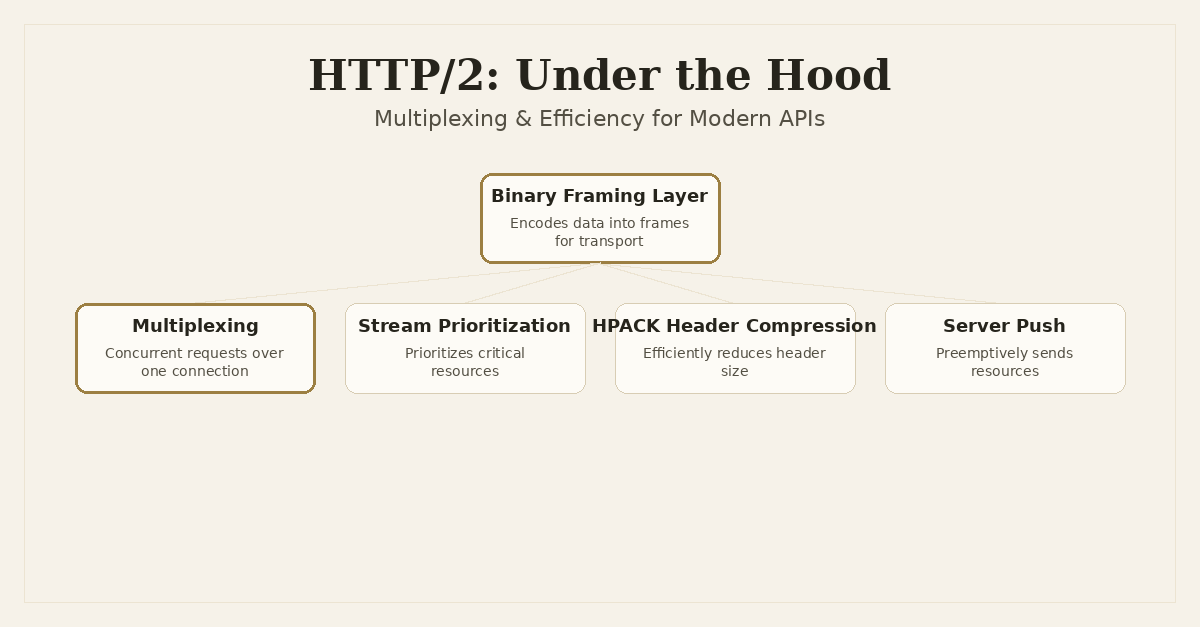
The key innovations that make HTTP/2 so powerful are:
- Binary Framing Layer: Everything is binary.
- Multiplexing: Multiple requests/responses over a single connection.
- Stream Prioritization: Clients can hint at what's most important.
- Header Compression (HPACK): Reduces overhead.
- Server Push: Proactive resource delivery.
Let's break these down.
1. The Binary Framing Layer: Speaking a New Language
One of the most significant changes in HTTP/2 is its use of a binary framing layer. Unlike HTTP/1.1, which sends messages as plain text, HTTP/2 breaks down all messages (headers, data, etc.) into smaller, self-contained binary units called frames. These frames are then mapped to streams, and multiple streams can be interleaved over a single TCP connection.
Each frame has a common header that identifies the stream it belongs to, its type (e.g., DATA, HEADERS, PRIORITY), and its length. This binary format is far more efficient for parsers, less error-prone, and enables other features like multiplexing.
Consider a simple HTTP/1.1 request:
GET /api/users/123 HTTP/1.1
Host: example.com
User-Agent: MyApiClient/1.0
Accept: application/json
In HTTP/2, this would be encoded into a series of binary frames. The headers would go into a HEADERS frame, and any request body (e.g., for a POST request) into DATA frames. The client and server then speak this binary language, making parsing faster and less ambiguous.
2. Multiplexing: True Concurrency Over a Single Connection
This is perhaps the most impactful feature of HTTP/2. Instead of waiting for one request to complete before sending the next, HTTP/2 allows multiple requests and responses to be in flight simultaneously over a single TCP connection. This means no more head-of-line blocking at the application layer.
How does it work? Each request/response exchange is assigned a unique stream ID. The binary frames from different streams can be interleaved on the wire. The client and server then reassemble these frames into their respective messages based on their stream IDs. It's like having multiple logical channels running concurrently within one physical pipe.
Think about our attendance-management-system project. If a client needed to fetch a user's schedule, their attendance history, and update their location simultaneously, in HTTP/1.1, that might be three separate TCP connections or one after another. With HTTP/2, all three could happen over the same connection, drastically cutting down on connection setup overhead and latency.
Here’s a conceptual look at how multiplexing changes the game:
HTTP/1.1 (Conceptual Blocking)
Client ---[Req A]---> Server
Client <---[Resp A]--- Server
Client ---[Req B]---> Server
Client <---[Resp B]--- Server
Client ---[Req C]---> Server
Client <---[Resp C]--- Server
HTTP/2 (Conceptual Multiplexing)
Client ---[Req A]---> Server
Client ---[Req B]---> Server
Client ---[Req C]---> Server
Client <---[Resp A]--- Server (interleaved with B, C)
Client <---[Resp B]--- Server (interleaved with A, C)
Client <---[Resp C]--- Server (interleaved with A, B)
This dramatically improves perceived load times and API responsiveness, especially for clients that need to fetch many small pieces of data or make several API calls to compose a single view.
3. Stream Prioritization: Guiding the Server
With multiplexing, a client might have many active streams. But not all resources are equally important. HTTP/2 introduces stream prioritization, allowing the client to hint to the server which streams are more critical. For example, a client might prioritize loading a critical CSS file or a user's essential profile data over a less important analytics script or a background API call.
Clients can assign a weight to each stream and specify dependencies between streams. The server then uses this information to allocate its resources (CPU time, bandwidth) more effectively, sending higher-priority data first. This ensures that the most critical parts of your application or API response are delivered as quickly as possible, even under network congestion.
4. HPACK Header Compression: Saving Bandwidth
As mentioned, HTTP/1.1's text-based headers are verbose and repetitive. HTTP/2 addresses this with HPACK, a compression format specifically designed for HTTP headers. HPACK works by:
- Static Table: A predefined list of common header fields and their values (e.g.,
content-type: application/json). - Dynamic Table: A table that's built up and maintained during the connection, storing header fields and values that have been sent previously.
- Huffman Encoding: For string values that aren't in the tables, they are Huffman encoded to reduce their size.
Instead of sending the full User-Agent string with every request, the client might send an index into the static table for common parts, and then a reference to the dynamic table for custom values. This can lead to significant bandwidth savings, especially for API calls where headers can sometimes be larger than the actual payload, or in microservice architectures where many small requests with similar headers are made.
For example, if the Dronzer AI Gateway makes frequent calls to different LLM providers, and each call carries similar authentication headers or Accept headers, HPACK would ensure these are sent only once or as tiny index references, reducing the network footprint.
5. Server Push: Proactive Delivery
Server Push allows the server to send resources to the client before the client explicitly requests them. If the server knows that when a client requests /api/user/profile, it will always subsequently request /api/user/settings and /api/user/avatar, the server can push those resources proactively. This eliminates round trips and drastically speeds up resource loading.
While more commonly associated with serving web assets (HTML, CSS, JS), Server Push can also be valuable for APIs. Imagine an API endpoint that, when called, consistently triggers the need for a few related data sets. The server could push these related data sets, reducing the total time the client spends waiting. However, it requires careful implementation to avoid pushing unwanted resources and wasting bandwidth.
Impact on API Design and Microservices
HTTP/2 fundamentally changes how we think about API communication, especially in a microservices context:
- Reduced Latency: Multiplexing eliminates HOL blocking, and reduced connection overhead means faster response times for clients making multiple API calls.
- Improved Throughput: More efficient use of a single TCP connection means more data can be transferred in the same amount of time.
- Simpler Client-Side Logic: Clients don't need to manage a pool of TCP connections for concurrent requests, simplifying their networking layer.
- Better for Chatty APIs: Microservices often involve many small, interconnected API calls. HTTP/2 shines here, making these interactions far more efficient.
- Header Bloat Mitigation: HPACK is a direct attack on common header bloat issues in complex API ecosystems.
This is particularly relevant for projects like Snapfix, where the VS Code extension might be making multiple calls to the backend (e.g., for traceback analysis, streaming AI suggestions, logging telemetry). HTTP/2 ensures these concurrent calls are handled efficiently without blocking each other.
Implementation Considerations
Modern web servers and clients largely support HTTP/2 out of the box. Most browsers automatically use HTTP/2 when available, and many server technologies provide support:
-
Nginx: As a reverse proxy, Nginx supports HTTP/2. You typically enable it in your
listendirective:server { listen 443 ssl http2; # Enable HTTP/2 for HTTPS listen [::]:443 ssl http2; server_name example.com; ssl_certificate /etc/letsencrypt/live/example.com/fullchain.pem; ssl_certificate_key /etc/letsencrypt/live/example.com/privkey.pem; location / { proxy_pass http://localhost:8000; # Proxy to your FastAPI app proxy_http_version 1.1; # Backend can still be HTTP/1.1 proxy_set_header Upgrade $http_upgrade; proxy_set_header Connection ""; proxy_set_header Host $host; proxy_set_header X-Real-IP $remote_addr; proxy_set_header X-Forwarded-For $proxy_add_x_forwarded_for; proxy_set_header X-Forwarded-Proto $scheme; } }Notice
proxy_http_version 1.1;inside thelocationblock. This is important: Nginx can communicate with your client over HTTP/2, but then proxy requests to your backend application (e.g., a Gunicorn/Uvicorn FastAPI app) using HTTP/1.1. This is a common and perfectly valid setup, as the performance gains are often realized at the edge (client-to-proxy). -
Uvicorn/ASGI Servers: If your Python ASGI application (like FastAPI) needs to speak HTTP/2 directly, Uvicorn supports it. However, in production, it's more common to have a reverse proxy like Nginx or Caddy handle the HTTP/2 termination, as shown above.
-
Client Libraries: Most modern HTTP client libraries (e.g.,
httpxin Python,fetchAPI in JavaScript, OkHttp in Java) support HTTP/2 automatically when connecting to a server that advertises HTTP/2 support via TLS ALPN (Application-Layer Protocol Negotiation).Using
httpxin Python, for example, it will attempt HTTP/2 by default if the server supports it:import httpx import asyncio async def fetch_multiple_apis(): async with httpx.AsyncClient(http2=True) as client: # These requests will be multiplexed over a single connection # if the server supports HTTP/2 responses = await asyncio.gather( client.get('https://api.example.com/users/1'), client.get('https://api.example.com/products/2'), client.post('https://api.example.com/orders', json={'item': 'new'}) ) for resp in responses: print(f"Status: {resp.status_code}, URL: {resp.url}") # print(resp.json()) # Assuming JSON response if __name__ == '__main__': asyncio.run(fetch_multiple_apis())This
httpxexample demonstrates how a client can transparently benefit from HTTP/2's multiplexing. Theasyncio.gatherensures these are initiated concurrently, and if the server supports HTTP/2,httpxhandles the multiplexing over a single underlying TCP connection.
Trade-offs and When to Use
HTTP/2 isn't a silver bullet for every scenario, though its benefits are widespread:
- TLS Requirement: While technically not mandatory, almost all browsers and major implementations only support HTTP/2 over TLS (HTTPS). This is generally a good thing for security, but it means you'll need to set up SSL certificates.
- Overhead for Single, Large Requests: For applications that primarily make a single, very large request (e.g., downloading a huge file) per connection, the gains from multiplexing might be minimal, and the additional complexity of the binary framing layer might add slight overhead. However, this is rarely the dominant use case for modern APIs.
- Proxy Compatibility: Ensure your load balancers, firewalls, and other network intermediaries are HTTP/2 compatible. Most modern infrastructure is, but it's worth checking.
For the vast majority of modern web applications and API-driven services, especially those built with microservices or requiring high concurrency and low latency, HTTP/2 is a clear win. It's the standard for good reason.
Looking Ahead: HTTP/3 and QUIC
While HTTP/2 brought significant improvements, it still runs over TCP. TCP, despite its robustness, can suffer from its own form of head-of-line blocking if packets are lost (TCP itself will retransmit, blocking all streams on that connection until the lost packet is recovered). This is where HTTP/3 comes in.
HTTP/3 uses QUIC (Quick UDP Internet Connections) as its transport layer instead of TCP. QUIC runs over UDP, but it builds in many of TCP's reliability features (like congestion control, retransmission) at the application layer, per stream. This means that a lost packet for one stream won't block other independent streams on the same connection. It also integrates TLS 1.3 directly into the handshake, further reducing connection setup latency.
HTTP/3 is still gaining widespread adoption, but it represents the next evolution of efficient web communication, addressing the remaining bottlenecks that HTTP/2 couldn't fully solve due to its reliance on TCP.
Conclusion
HTTP/2 has fundamentally reshaped how we build and deliver high-performance applications and APIs. Its binary framing, multiplexing, header compression, and server push capabilities directly tackle the inefficiencies of HTTP/1.1, leading to faster load times, reduced latency, and more efficient network utilization.
As engineers, understanding these underlying protocols is just as important as optimizing our application code. By leveraging HTTP/2 (and keeping an eye on HTTP/3), we can ensure our systems, from real-time attendance platforms to intelligent AI gateways, communicate with the speed and resilience that modern users expect. It’s a core piece of the puzzle for building truly performant and scalable backend services.
Frequently Asked Questions
What problem does HTTP/2 solve compared to HTTP/1.1?
HTTP/2 primarily addresses HTTP/1.1's head-of-line (HOL) blocking, high connection overhead, and inefficient request/response model by introducing multiplexing, binary framing, and header compression.
How does multiplexing work in HTTP/2?
HTTP/2 multiplexing allows multiple requests and responses to be sent concurrently over a single TCP connection. It breaks messages into frames, interleaves them, and reassembles them on the other end, eliminating HOL blocking.
What is HPACK and why is it important for HTTP/2 performance?
HPACK is the header compression scheme used in HTTP/2. It reduces the size of HTTP headers by encoding common headers into a static table and dynamically updating a shared table for subsequent requests, significantly cutting down on bandwidth usage.
Can HTTP/2 be used for REST APIs, or is it only for web pages?
Absolutely. HTTP/2 is highly beneficial for REST APIs. Its features like multiplexing and header compression are particularly effective for microservices architectures, reducing latency and improving throughput for API calls, especially when many small requests are made concurrently.
Written by Ansh Gautam
Full-stack engineer building production systems with FastAPI, React, and AI/LLM integrations. Currently looking for backend engineering & AI integration roles.