Architecting for Resilience: A Deep Dive into Event-Driven Systems
I've built systems that needed to handle unpredictable loads and maintain high availability. Event-driven architectures offered a robust solution for decoupling services and scaling asynchronously.
I've spent a lot of time building systems that need to be fast, reliable, and able to handle whatever load gets thrown at them. One of the biggest challenges in distributed systems, especially as they grow, is managing dependencies between services. When everything is tightly coupled—service A calls service B, which then calls service C—a failure in any single component can bring down the entire chain. Scaling also becomes a nightmare; you're often forced to scale all services together, even if only one is experiencing heavy load.
This is a problem I've tackled repeatedly, whether it was ensuring real-time attendance updates propagated reliably or orchestrating complex LLM interactions across multiple providers. The solution, more often than not, involves moving towards an event-driven architecture (EDA). It's a fundamental shift from synchronous, request-response communication to asynchronous, event-based interactions. It's not a silver bullet, but when applied correctly, it dramatically improves scalability, resilience, and maintainability.
What is Event-Driven Architecture?
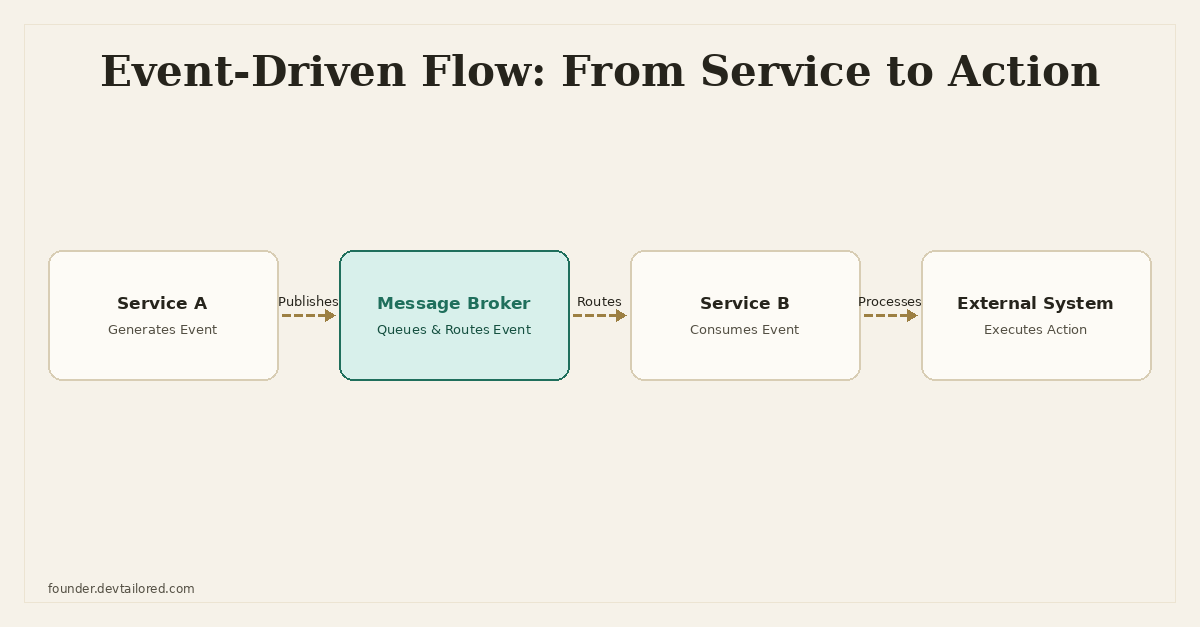
At its core, an event-driven architecture is a software design pattern where services communicate by emitting and reacting to events. An event is simply a record of something that happened in the system. It's an immutable fact, like UserSignedUp, OrderProcessed, or AttendanceRecorded. Instead of directly calling another service's API, a service publishes an event to a central component, often called a message broker. Other services interested in that event can then subscribe to it and react accordingly, without the publisher knowing or caring who the subscribers are.
Why Bother with EDA?
- Decoupling: Services become independent. A producer doesn't need to know about its consumers, and vice-versa. This reduces tight coupling, making services easier to develop, deploy, and scale independently.
- Scalability: Since communication is asynchronous, services can process events at their own pace. If a consumer is slow, the message broker buffers events, preventing backpressure from affecting the producer. You can scale consumers horizontally by adding more instances.
- Resilience: If a consumer service goes down, the events simply queue up in the message broker. When the service recovers, it can pick up where it left off, processing the backlog. This prevents cascading failures common in synchronous systems.
- Asynchronous Processing: Long-running tasks can be offloaded. A web request can quickly return a
202 Acceptedresponse after publishing an event, letting a background worker handle the heavy lifting. This improves user experience and API responsiveness. - Extensibility: Adding new functionality often means adding a new consumer that reacts to existing events, without modifying existing services.
Core Components of an Event-Driven System
An EDA typically consists of three main components:
- Event Producers: These are services or applications that generate and publish events. They don't care who consumes the events or what happens next; they simply announce that something has occurred.
- Events: These are immutable, timestamped records of facts. They describe what happened, not how to react to it. A good event contains enough context for consumers to act upon it.
- Message Broker (or Event Bus): This is the central hub. It receives events from producers and routes them to interested consumers. It's responsible for reliable delivery, persistence, and often, ordering guarantees.
- Event Consumers: These are services or applications that subscribe to specific events from the message broker and react to them by performing some business logic. A single event can have multiple consumers.
Message Queues: The Backbone of EDA
Message brokers come in various forms, each with its strengths and weaknesses. The choice depends heavily on your specific requirements for throughput, latency, persistence, and ordering.
RabbitMQ
RabbitMQ is a popular open-source message broker that implements the Advanced Message Queuing Protocol (AMQP). It's often used for traditional message queuing patterns, like work queues and publish/subscribe. It excels at reliable message delivery and has a rich set of features like message acknowledgments, dead-letter queues, and complex routing.
Apache Kafka
Kafka is a distributed streaming platform designed for high-throughput, fault-tolerant data streaming. Unlike traditional message queues that remove messages after consumption, Kafka retains messages for a configurable period, allowing multiple consumers to read the same stream independently. It's ideal for event sourcing, log aggregation, and real-time data pipelines.
Redis Streams
Redis, primarily an in-memory data store, also offers Streams. These are append-only data structures that act like a log, similar to Kafka, but within the Redis ecosystem. They're great for simpler, high-performance use cases where you already use Redis and need basic stream processing capabilities without the overhead of a full-fledged Kafka cluster.
Common Event-Driven Patterns
1. Publish/Subscribe (Pub/Sub)
This is the most common pattern. A producer publishes an event to a specific topic or exchange, and multiple consumers can subscribe to that topic. Each subscribing consumer receives a copy of the event. This is perfect for broadcasting information, like a ProductUpdated event that needs to trigger updates in a search index, a caching layer, and a recommendation engine.
2. Work Queues (Task Queues)
In a work queue, a producer sends tasks (events) to a queue, and multiple consumers compete to process these tasks. Each task is processed by only one consumer. This pattern is ideal for distributing computationally intensive jobs, like image processing, report generation, or bulk email sending, across a pool of workers.
Building an Event-Driven System in Python
Let's look at a simplified example using pika, a Python client library for RabbitMQ. This setup demonstrates a basic work queue for processing OrderProcessed events.
First, install pika: pip install pika
Producer: Emitting an OrderProcessed Event
Our producer will simulate an e-commerce service that processes an order and then publishes an event to a queue, indicating that the order is ready for fulfillment or notification.
import pika
import json
import time
import uuid

def publish_order_processed_event(order_id: str, customer_email: str, items: list):
    connection = pika.BlockingConnection(pika.ConnectionParameters('localhost'))
    channel = connection.channel()

    # Declare a durable queue to ensure messages persist even if RabbitMQ restarts
    channel.queue_declare(queue='order_processing_queue', durable=True)

    event_data = {
        'event_id': str(uuid.uuid4()),
        'event_type': 'OrderProcessed',
        'timestamp': time.time(),
        'payload': {
            'order_id': order_id,
            'customer_email': customer_email,
            'items': items
        }
    }
    message_body = json.dumps(event_data)

    # Publish the message to the queue
    channel.basic_publish(
        exchange='', # Default exchange for direct queue publishing
        routing_key='order_processing_queue',
        body=message_body,
        properties=pika.BasicProperties(
            delivery_mode=pika.DeliveryMode.Persistent # Make message persistent
        )
    )
    print(f" [x] Sent 'OrderProcessed' event for order {order_id}")
    connection.close()

if __name__ == '__main__':
    # Simulate some orders being processed
    publish_order_processed_event("ORD-001", "alice@example.com", [{"product": "Laptop", "qty": 1}])
    time.sleep(0.5)
    publish_order_processed_event("ORD-002", "bob@example.com", [{"product": "Mouse", "qty": 2}, {"product": "Keyboard", "qty": 1}])
    time.sleep(0.5)
    publish_order_processed_event("ORD-003", "charlie@example.com", [{"product": "Monitor", "qty": 1}])
Consumer: Reacting to OrderProcessed Events
Our consumer will act as a fulfillment service, taking OrderProcessed events from the queue and simulating the fulfillment process.
import pika
import json
import time

def callback(ch, method, properties, body):
    event_data = json.loads(body)
    order_id = event_data['payload']['order_id']
    customer_email = event_data['payload']['customer_email']
    items = event_data['payload']['items']

    print(f" [x] Received 'OrderProcessed' event for order {order_id}")
    print(f"     Customer: {customer_email}, Items: {items}")

    # Simulate some work (e.g., updating inventory, sending fulfillment request)
    time.sleep(2)

    print(f" [x] Order {order_id} processed. Acknowledging message.")
    # Acknowledge the message to remove it from the queue
    ch.basic_ack(delivery_tag=method.delivery_tag)

def start_consumer():
    connection = pika.BlockingConnection(pika.ConnectionParameters('localhost'))
    channel = connection.channel()

    # Declare the same durable queue as the producer
    channel.queue_declare(queue='order_processing_queue', durable=True)

    # Prefetch count: tell RabbitMQ not to give more than 1 message at a time to a worker
    # This ensures fair dispatch and prevents a busy worker from hogging messages.
    channel.basic_qos(prefetch_count=1)

    channel.basic_consume(queue='order_processing_queue', on_message_callback=callback)

    print(' [*] Waiting for messages. To exit press CTRL+C')
    channel.start_consuming()

if __name__ == '__main__':
    try:
        start_consumer()
    except KeyboardInterrupt:
        print(' Interrupted')
        # In a real application, you'd close the connection gracefully here.
To run this, you'd need a RabbitMQ instance running locally (e.g., via Docker). Then, start the consumer script in one terminal and the producer script in another. You'll see the producer sending events and the consumer picking them up, even if you start multiple consumer instances (they'll share the load).
Advanced Considerations and Trade-offs
While EDA offers significant benefits, it introduces its own set of complexities.
1. Eventual Consistency
In an event-driven system, data across different services might not be immediately consistent. When an event is published, consumers process it asynchronously. This means there's a delay before all services reflect the change. This concept is called eventual consistency. You need to design your system and user experience around this. For example, a user might see their order as 'processing' for a few seconds before it updates to 'confirmed'.
2. Idempotency
Message brokers, for reliability, often deliver messages at least once. This means a consumer might receive the same event multiple times, especially during network outages or consumer restarts. Your consumers must be idempotent, meaning processing the same event multiple times has the same effect as processing it once. For our OrderProcessed event, the fulfillment service should ensure it doesn't fulfill the same order twice. This often involves tracking processed event_ids in a database or using unique keys in update operations.
# Example of idempotent processing logic
def process_order_idempotently(order_id: str, event_id: str):
    # Check if this event_id has already been processed
    if is_event_processed(event_id): # Function to query a database/cache
        print(f" [!] Event {event_id} for order {order_id} already processed. Skipping.")
        return

    # Perform actual processing
    print(f" [x] Processing order {order_id} with event {event_id}...")
    # ... (actual business logic)

    # Mark event as processed
    mark_event_as_processed(event_id) # Function to store event_id
3. Message Ordering
While some message brokers (like Kafka within a single partition) guarantee strict ordering, others (like RabbitMQ in certain configurations) might not. If the order of events is critical (e.g., AccountDebited must always precede AccountCredited), you need to ensure your broker and consumer logic maintain this. This might involve using a single consumer for a specific entity or using sequence numbers within events.
4. Dead-Letter Queues (DLQ)
What happens when a message consumer repeatedly fails to process an event? Without a mechanism to handle these "poison messages," they could block the queue or be lost. Dead-Letter Queues (DLQs) are dedicated queues where messages that cannot be processed successfully after a certain number of retries are sent. This allows developers to inspect failed messages, debug the consumer, and potentially re-process them later, preventing data loss and service disruption.
5. Monitoring and Observability
In a distributed, asynchronous system, understanding what's happening becomes more complex. You need robust monitoring for:
- Queue Lengths: Are messages piling up? This indicates a bottleneck in your consumers.
- Consumer Lag: How far behind are your consumers in processing events?
- Message Throughput: How many messages are being produced and consumed per second?
- Error Rates: Which consumers are failing, and on which types of events?
Tools like Prometheus, Grafana, and distributed tracing (e.g., OpenTelemetry) become critical for gaining visibility into the flow of events and debugging issues.
6. Event Schema Management
As your system evolves, event schemas will change. Managing these changes backward-compatibly is crucial. Using schema registries (like Confluent Schema Registry for Kafka) and versioning your events helps ensure that older consumers can still process newer events, or at least fail gracefully.
When to Use and When to Avoid EDA
Use EDA when:
- Your system requires high scalability and resilience.
- You have long-running background tasks that shouldn't block user requests.
- You need to integrate many disparate services or systems.
- You're building data pipelines or event sourcing architectures.
- You want to promote loose coupling and independent deployments of services.
Avoid EDA when:
- You need strict, immediate consistency across all services (though often, eventual consistency is acceptable).
- Your system is very simple, with only a few tightly coupled components where the overhead of a message broker isn't justified.
- Debugging and monitoring distributed asynchronous flows is too complex for your team's current capabilities.
Wrapping Up
Event-driven architectures are a powerful pattern for building modern, scalable, and resilient distributed systems. They shift the paradigm from direct calls to reactions, leading to more flexible and robust applications. The journey involves understanding not just the benefits, but also the challenges around eventual consistency, idempotency, and observability. But by thoughtfully designing your events, choosing the right message broker, and implementing robust consumer logic, you can build systems that truly stand the test of production load.
Frequently Asked Questions
What problem does event-driven architecture solve?
Event-driven architecture decouples services, allowing them to operate independently and asynchronously. This significantly improves scalability, resilience, and maintainability by reducing direct service-to-service dependencies and preventing cascading failures.
What are the core components of an event-driven system?
The core components include events (immutable facts about something that happened), event producers (services that emit events), event consumers (services that react to events), and a message broker (a central component that routes events reliably between producers and consumers).
When should I consider using an event-driven architecture?
Consider an event-driven architecture for systems requiring high scalability, resilience to partial failures, asynchronous processing of tasks, complex data processing pipelines, or when integrating many disparate microservices that need to communicate without tight coupling.
What are some common challenges in implementing event-driven systems?
Key challenges include managing eventual consistency across services, ensuring correct message ordering, implementing idempotency in consumers to handle duplicate messages, monitoring message flow and processing latency, and debugging distributed state changes across multiple services.
Written by Ansh Gautam
Full-stack engineer building production systems with FastAPI, React, and AI/LLM integrations. Currently looking for backend engineering & AI integration roles.