Engineering Trust: Building Robust LLM Evaluation Frameworks in Production
Deploying LLM applications means confronting inherent unpredictability. This post dives into architecting robust evaluation frameworks to systematically measure quality, consistency, and reliability in production.
Engineering Trust: Building Robust LLM Evaluation Frameworks in Production
Shipping an LLM-powered application is one thing. Ensuring it consistently performs as expected, delivers high-quality outputs, and remains robust against various inputs in a production environment is a completely different challenge. I've found that the inherent non-determinism and subjective nature of LLM outputs mean our traditional software testing methodologies often fall short. It's not enough to say, "it works on my machine." We need to engineer trust.
When I was building Snapfix, an AI-powered VS Code extension that suggests code fixes, the definition of a "good" fix went far beyond simply compiling. It had to be idiomatic Python, safe, and genuinely helpful to the developer. Similarly, with Dronzer AI Gateway, my AI orchestration engine, the goal is to route requests across 45+ LLM providers with task-aware intelligence and bulletproof failover. How do I know the routing decision was optimal? How do I ensure output quality consistency across vastly different models for the same prompt? These aren't questions a simple assert_equals can answer.
This is where robust LLM evaluation frameworks become critical. They are the scaffolding that lets us systematically measure quality, identify regressions, and validate improvements, turning the fuzzy art of prompt engineering into a more reliable engineering discipline.
The Fundamental Challenge: Why LLMs Break Traditional Testing
Traditional software testing relies heavily on deterministic behavior. Given an input, a function should always produce the same, predictable output. LLMs fundamentally challenge this premise:
- Non-determinism: Even with a fixed
temperature=0, LLMs can produce slightly different outputs on successive runs due to internal sampling mechanisms or distributed training nuances. This makes direct string comparison unreliable. - Subjectivity: What constitutes a "good" or "correct" answer can be highly subjective. A code fix might be syntactically correct but stylistically poor. A summary might capture the main points but miss a critical nuance. There isn't always one canonical "right" answer.
- Context-Dependence: The quality of an LLM's response is highly dependent on the prompt, the system instructions, retrieval context (in RAG), and even the preceding turns in a conversation. Isolating variables for testing is difficult.
- Semantic Ambiguity: LLMs deal with language, which is inherently ambiguous. Exact keyword matching or regex can be brittle and miss semantically equivalent but lexically different responses.
Given these challenges, we can't just write a bunch of unit tests and call it a day. We need a multi-faceted approach to evaluation.
Pillars of LLM Evaluation: Methods and Metrics
I break down LLM evaluation into several key categories, each with its strengths and use cases.
1. Heuristic and Rule-Based Checks
These are the simplest and often the first line of defense. They involve checking for specific patterns, keywords, or structural properties of the output. While limited in capturing semantic quality, they are fast, cheap, and excellent for enforcing basic constraints.
Use Cases:
- JSON Schema Validation: Ensuring the output conforms to a
Pydanticmodel or JSON schema, crucial for structured output tasks. This is something I rely on heavily whenDronzer AI Gatewayroutes a request for a specific tool call. - Keyword Presence/Absence: Verifying that certain critical terms are present or that undesirable terms are absent.
- Length Constraints: Checking if summaries are within a specified token or word count.
- Function Call Validation: If the LLM is supposed to output a function call, validating its format and arguments.
Example: Basic JSON Schema Validation
Let's say Snapfix is asked to suggest a code refactoring. We might expect a structured output detailing the change, rationale, and a code block. We can validate this using Pydantic.
from pydantic import BaseModel, Field, ValidationError
import json

class CodeRefactoringSuggestion(BaseModel):
    """Represents a suggested code refactoring."""
    title: str = Field(description="A concise title for the refactoring.")
    rationale: str = Field(description="Explanation of why this refactoring is beneficial.")
    code_diff: str = Field(description="The actual code changes, in diff format or full code.")
    severity: str = Field(description="How critical this refactoring is (e.g., 'low', 'medium', 'high').")

def validate_refactoring_output(llm_output: str) -> bool:
    try:
        # Assuming LLM output is a JSON string
        data = json.loads(llm_output)
        CodeRefactoringSuggestion(**data)
        return True
    except (json.JSONDecodeError, ValidationError) as e:
        print(f"Validation failed: {e}")
        return False

# Example LLM output
good_output = '''
{
  "title": "Extract magic number to constant",
  "rationale": "Improves readability and maintainability by replacing a hardcoded value with a named constant.",
  "code_diff": "- if x > 100: \n+ THRESHOLD = 100\n+ if x > THRESHOLD:",
  "severity": "medium"
}
'''
bad_output = '''
{
  "title": "Missing rationale",
  "code_diff": "some code",
  "severity": "low"
}
'''

print(f"Good output validation: {validate_refactoring_output(good_output)}")
print(f"Bad output validation: {validate_refactoring_output(bad_output)}")
2. Embedding-Based Semantic Similarity
When exact matches aren't feasible, but semantic meaning is what matters, comparing vector embeddings of responses becomes powerful. This allows for nuanced comparisons that account for synonyms, rephrasing, and different sentence structures conveying the same information.
How it works: Both the LLM's output and a human-written golden response (or another LLM's output) are converted into dense vector embeddings using a pre-trained sentence transformer model. The cosine similarity between these vectors indicates how semantically close the two texts are.
Use Cases:
- Summarization Quality: Assessing if a generated summary captures the core meaning of a reference summary.
- Question Answering: Determining if an answer is contextually relevant and correct, even if phrased differently.
- Paraphrase Detection: Useful for
Snapfixto check if a suggested fix is genuinely new or just a rephrasing of the original code.
Example: Semantic Similarity Check (Conceptual)
from sentence_transformers import SentenceTransformer, util

# This model would be loaded once in a real application
# model = SentenceTransformer('all-MiniLM-L6-v2')

def calculate_semantic_similarity(text1: str, text2: str, model) -> float:
    embeddings1 = model.encode(text1, convert_to_tensor=True)
    embeddings2 = model.encode(text2, convert_to_tensor=True)
    cosine_similarity = util.cosine_similarity(embeddings1, embeddings2)
    return cosine_similarity.item()

# In a real setup, 'model' would be initialized once
# For demonstration, let's mock it or assume it's loaded
class MockSentenceTransformer:
    def encode(self, text, convert_to_tensor=True):
        # Simulate embedding generation - in reality, this is a complex neural net operation
        # For simplicity, just return a dummy tensor
        import torch
        # Each unique text gets a slightly different embedding for demo purposes
        if "hello world" in text.lower():
            return torch.tensor([0.1, 0.2, 0.3])
        elif "hi there" in text.lower():
            return torch.tensor([0.11, 0.21, 0.31])
        elif "different topic" in text.lower():
            return torch.tensor([0.9, 0.8, 0.7])
        return torch.tensor([0.5, 0.5, 0.5]) # Default for others

mock_model = MockSentenceTransformer()

llm_response = "The quick brown fox jumps over the lazy dog."
golden_response = "A speedy fox leaps over a lethargic canine."
disparate_response = "The cat sat on the mat."

# In reality, this would be a real SBERT model
# print(f"Similarity (LLM vs Golden): {calculate_semantic_similarity(llm_response, golden_response, model)}")
# print(f"Similarity (LLM vs Disparate): {calculate_semantic_similarity(llm_response, disparate_response, model)}")

# With mock model, we need to simulate the similarity more directly
# A real model would produce high similarity for semantically similar texts
# and low for dissimilar texts. For this mock, imagine `util.cosine_similarity`
# would return high for the first pair, low for the second.

# Conceptual output of a real model:
# Similarity (LLM vs Golden): ~0.85 (high)
# Similarity (LLM vs Disparate): ~0.20 (low)
3. LLM-as-a-Judge
This is a powerful technique where a more capable LLM (the "judge") is used to evaluate the output of another LLM (the "sut" - system under test) based on a predefined rubric. This method scales better than human evaluation and can capture nuanced quality aspects that simple heuristics miss.
How it works:
- Define a Rubric: Create clear, specific criteria for evaluation (e.g., correctness, coherence, conciseness, safety, style).
- Construct a Judge Prompt: Provide the judge LLM with the original prompt, the SUT's response, and a golden/reference response (optional). Crucially, include the rubric and ask the judge to score or provide feedback based on it.
- Parse Judge Output: The judge's output might be a numerical score, a structured JSON, or natural language feedback, which then needs to be parsed and aggregated.
Use Cases:
- Code Quality (Snapfix): Evaluating if a suggested code fix is not just correct, but also idiomatic Python, adheres to PEP8, and improves readability. A human might take minutes; an LLM judge can do it in seconds.
- Summarization & Content Generation: Assessing the factual accuracy, completeness, and tone of generated text.
- Routing Effectiveness (Dronzer AI Gateway): Given a prompt, and the outputs from two different models (e.g., one chosen by the router, one from a fallback), the judge can determine which output is superior for the given task and why, helping to refine routing logic.
Example: LLM-as-a-Judge for Code Fix Evaluation (Conceptual)
from typing import Dict, Any
import json
from litellm import completion # Using LiteLLM for multi-provider access

def evaluate_code_fix_with_llm_judge(
    original_code: str,
    problem_description: str,
    suggested_fix: str,
    judge_model: str = "gpt-4o", # Use a strong model for judging
    judge_api_key: str = "YOUR_OPENAI_API_KEY" # Or other provider key
) -> Dict[str, Any]:
    rubric = """
    Evaluate the suggested code fix based on the following criteria:
    1. Correctness (0-5): Does the fix solve the described problem without introducing new bugs? (5=Perfect, 0=Fails)
    2. Readability/Idiomatic Python (0-5): Is the code clean, readable, and follows Python best practices (e.g., PEP8)? (5=Excellent, 0=Poor)
    3. Safety (0-5): Does the fix avoid introducing security vulnerabilities or unexpected side effects? (5=Very safe, 0=Unsafe)
    4. Conciseness (0-5): Is the fix efficient and to the point, without unnecessary complexity? (5=Highly concise, 0=Overly complex)

    Provide a score for each criterion and a brief rationale for your overall assessment.
    Output your response as a JSON object with 'scores' and 'overall_rationale' keys.
    """

    prompt = f"""
    Original Code:
    ```python
    {original_code}
    ```

    Problem Description:
    {problem_description}

    Suggested Fix:
    ```python
    {suggested_fix}
    ```

    {rubric}
    """

    try:
        response = completion(
            model=judge_model,
            messages=[
                {"role": "system", "content": "You are an expert Python engineer tasked with evaluating code fixes."},
                {"role": "user", "content": prompt}
            ],
            temperature=0.0, # Keep judge deterministic
            response_format={"type": "json_object"} # Request structured output
        )
        judge_output = response.choices[0].message.content
        return json.loads(judge_output)
    except Exception as e:
        print(f"Error calling LLM judge: {e}")
        return {"error": str(e), "message": "Failed to get judge response"}

# Example usage for Snapfix
original_code_snippet = """
def calculate_sum(numbers):
    total = 0
    for num in numbers:
        total += num
    return total
"""
problem_statement = "This function is not Pythonic. It should use `sum()` built-in."
suggested_fix_snippet = """
def calculate_sum(numbers):
    return sum(numbers)
"""

# In a real application, you'd configure LiteLLM with API keys
# For demonstration, this would make an actual API call
# evaluation_result = evaluate_code_fix_with_llm_judge(
#     original_code=original_code_snippet,
#     problem_description=problem_statement,
#     suggested_fix=suggested_fix_snippet,
#     judge_model="gpt-4o",
#     judge_api_key="sk-..."
# )
# print(json.dumps(evaluation_result, indent=2))

# Expected (simulated) output structure:
# {
#   "scores": {
#     "Correctness": 5,
#     "Readability/Idiomatic Python": 5,
#     "Safety": 5,
#     "Conciseness": 5
#   },
#   "overall_rationale": "The fix correctly replaces the manual loop with the built-in `sum()` function, making the code significantly more Pythonic, concise, and readable without compromising correctness or safety."
# }
4. Human-in-the-Loop Evaluation
Despite the advancements in automated and LLM-as-a-judge methods, human evaluation remains the gold standard for subjective quality assessments and for establishing ground truth. It's expensive and slow, so it needs to be used strategically.
Use Cases:
- Golden Dataset Creation: Humans are essential for creating the initial high-quality examples that all other evaluation methods benchmark against.
- Adversarial Testing: Identifying edge cases, biases, or subtle failures that automated systems might miss.
- Critical Quality Assurance: For high-stakes applications where errors are costly, human review provides the final layer of scrutiny.
- Model Fine-tuning Feedback: Collecting human preferences to guide reinforcement learning from human feedback (RLHF).
Strategy: Instead of evaluating every single output, focus on sampling. Evaluate a diverse subset of prompts, especially those that automated methods flag as problematic or borderline. This is how I'd approach refining Snapfix's suggestions – a human developer would ultimately confirm if the fix is truly production-ready.
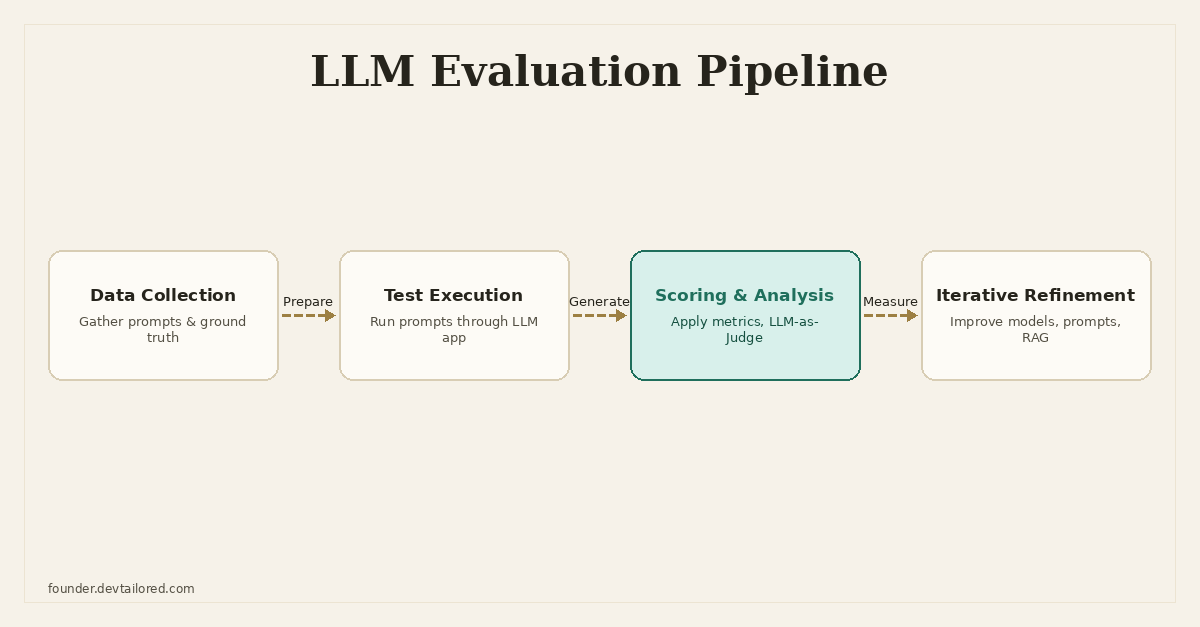
Architecting an LLM Evaluation Pipeline
Integrating these methods into a continuous, repeatable process is key. Here's how I envision a robust evaluation pipeline:
1. Golden Datasets and Test Sets
This is the foundation. A "golden dataset" is a collection of input prompts paired with meticulously crafted, human-verified "ground truth" responses. These are your benchmarks.
- Diversity: Ensure your dataset covers a wide range of use cases, prompt variations, and expected output complexities.
- Version Control: Treat golden datasets as code. Version them. If you change your prompt or model, your evaluation results should be comparable against a fixed, versioned dataset.
- Continuous Expansion: As your application evolves and you discover new edge cases or failure modes, add them to your golden dataset.
For Snapfix, this would involve problematic code snippets and the ideal fix, along with explanations. For Dronzer AI Gateway, it would be specific tasks with desired outputs from an optimally routed model.
2. The Evaluation Harness
This is the engine that runs your tests. It orchestrates:
- Prompt Execution: Sending prompts from your golden dataset to your LLM application (or directly to different models via
LiteLLMorDronzer AI Gateway). - Output Collection: Storing the LLM's raw responses.
- Metric Application: Applying all the chosen evaluation metrics (heuristics, semantic similarity, LLM-as-a-judge).
- Result Storage: Saving scores and feedback in a structured format (e.g., CSV, database, JSON files) for analysis.
import pandas as pd
from typing import List, Dict, Callable

# Assume we have a function to call our LLM service
def call_llm_service(prompt: str, model_id: str) -> str:
    # In a real scenario, this would call your FastAPI endpoint,
    # or LiteLLM directly, possibly via Dronzer AI Gateway
    # For demo, just echo or return a placeholder
    if "fix this code" in prompt.lower():
        return "```python\n# Fixed code\nprint('Hello from fixed code')\n```"
    return f"LLM response for: {prompt}"

class EvaluationHarness:
    def __init__(self, golden_dataset: List[Dict[str, str]], evaluators: Dict[str, Callable]):
        self.golden_dataset = golden_dataset
        self.evaluators = evaluators # {'metric_name': callable_function}
        self.results = []

    def run_evaluation(self, model_to_test: str):
        print(f"\n--- Running evaluation for model: {model_to_test} ---")
        for i, entry in enumerate(self.golden_dataset):
            prompt = entry["prompt"]
            golden_response = entry["golden_response"]

            print(f"\n  Evaluating prompt {i+1}: {prompt[:50]}...")
            llm_output = call_llm_service(prompt, model_to_test)

            evaluation_scores = {"prompt_id": i, "prompt": prompt, "llm_output": llm_output, "golden_response": golden_response}

            for metric_name, evaluator_func in self.evaluators.items():
                try:
                    score = evaluator_func(llm_output, golden_response) # Or (llm_output, prompt, golden_response) for judge
                    evaluation_scores[metric_name] = score
                except Exception as e:
                    evaluation_scores[metric_name] = f"ERROR: {e}"

            self.results.append(evaluation_scores)
        print("--- Evaluation complete ---")
        return pd.DataFrame(self.results)

# Example Evaluators
def simple_keyword_check(llm_output: str, golden_response: str) -> bool:
    # Simplified: check if 'fixed' is in LLM output, and 'sum' in golden (for code fix context)
    return "fixed" in llm_output.lower() and "sum" in golden_response.lower()

def mock_semantic_similarity(llm_output: str, golden_response: str) -> float:
    # In a real scenario, this would use SentenceTransformer
    # For demo, just return a dummy score based on length diff
    diff_ratio = abs(len(llm_output) - len(golden_response)) / max(len(llm_output), len(golden_response), 1)
    return max(0.0, 1.0 - diff_ratio) # Higher is better

# Mock golden dataset for Snapfix context
snapfix_golden_dataset = [
    {"prompt": "Fix this Python code: `def f(a): return a+1`", "golden_response": "def increment(value): return value + 1"},
    {"prompt": "Refactor this: `x=0; for i in range(10): x+=i`", "golden_response": "sum(range(10))"}
]

# Initialize harness with dataset and evaluators
harness = EvaluationHarness(
    golden_dataset=snapfix_golden_dataset,
    evaluators={
        "keyword_check": simple_keyword_check,
        "semantic_similarity": mock_semantic_similarity
    }
)

# Run evaluation for a hypothetical 'snapfix-v1' model
eval_df = harness.run_evaluation(model_to_test="snapfix-v1")
print(eval_df.head())
3. Reporting and Visualization
Raw scores aren't enough. You need to visualize trends, identify regressions, and understand performance across different dimensions.
- Dashboards: Tools like
Streamlit,Plotly Dash, or even simpleMatplotlibgraphs can visualize average scores, per-category performance, and historical trends. - Error Analysis: Don't just look at aggregate numbers. Dig into specific failures. Why did the LLM-as-a-judge score something low? What was the human feedback? This is where you find patterns for prompt engineering or model fine-tuning.
- A/B Testing: Compare different prompt versions, model configurations, or routing strategies directly using the evaluation harness.
4. Continuous Evaluation (CI/CD Integration)
To prevent regressions and ensure ongoing quality, integrate evaluation into your CI/CD pipeline.
- Pre-deployment Gates: Before deploying a new model version or a significant prompt change, run your evaluation suite. If key metrics drop below a threshold, block the deployment.
- Post-deployment Monitoring: Continuously evaluate a small sample of live traffic to detect drift or sudden performance degradation.
- Alerting: Set up alerts for significant drops in evaluation scores.
This is something I'd want for Dronzer AI Gateway – if a new model integration or routing algorithm is deployed, I need to know immediately if it degrades performance for critical tasks across various providers.
Lessons Learned and Best Practices
- Start Simple, Iterate: Don't try to build the perfect evaluation system overnight. Start with basic heuristic checks and a small golden dataset. Gradually add more sophisticated metrics and expand your dataset as your understanding of failure modes grows.
- Golden Datasets are Gold: Invest heavily in creating and maintaining high-quality, diverse golden datasets. They are the bedrock of reliable evaluation.
- Combine Methods: No single evaluation method is perfect. Combine automated checks for speed, LLM-as-a-judge for scalability and nuance, and human review for ultimate ground truth and edge case discovery.
- Version Everything: Prompts, models, evaluation rubrics, and golden datasets must all be versioned. Reproducibility is paramount.
- Focus on Actionable Insights: Evaluation isn't just about getting a score; it's about understanding why the score is what it is and what steps you can take to improve it. Error analysis is often more valuable than aggregate metrics.
- Cost Awareness: LLM-as-a-judge incurs API costs. Design your sampling and judge prompt carefully to balance thoroughness with budget.
Building reliable LLM applications in production is a journey, not a destination. The inherent variability of these models means that evaluation isn't a one-off task but a continuous process. By investing in robust evaluation frameworks, we can move beyond hope and guesswork, and truly engineer trust into our AI systems, ensuring they deliver consistent, high-quality results for our users.
It's about having the tools and processes in place to continuously ask: Is this working as intended? How well? And how can we make it better? That's the core of building production-ready AI.
Frequently Asked Questions
Why is traditional unit testing insufficient for LLM applications?
Traditional unit tests struggle with LLMs because their outputs are often non-deterministic, subjective, and context-dependent. A 'correct' answer might have multiple valid forms, making rigid assertion difficult. We need methods that can handle nuance and variability.
What are the core components of a comprehensive LLM evaluation pipeline?
A robust evaluation pipeline typically includes: establishing golden datasets with diverse prompts and expected outputs, a test harness to execute prompts against models, various scoring mechanisms (automated metrics, LLM-as-a-judge, human review), and an iterative feedback loop for continuous refinement.
How can 'LLM-as-a-judge' be effectively used and what are its limitations?
'LLM-as-a-judge' involves using a more capable LLM to evaluate the output of another model based on a predefined rubric. It's efficient for scaling evaluation and capturing semantic quality, but it can be biased by the judge model, incur additional cost, and requires careful prompt engineering for the rubric itself.
What role do golden datasets play in evaluating LLM performance?
Golden datasets are curated collections of prompts paired with high-quality, human-verified 'ground truth' responses. They serve as a benchmark for measuring an LLM's performance, helping to identify regressions, compare models, and validate improvements across different iterations or model versions.
Written by Ansh Gautam
Full-stack engineer building production systems with FastAPI, React, and AI/LLM integrations. Currently looking for backend engineering & AI integration roles.