Ensuring Temporal Consistency: Handling Out-of-Order Real-Time Location Data
I ran into a tricky problem with my real-time attendance system where stale location data, arriving out of order, was incorrectly marking students absent or present. This devlog details how I implemented server-side temporal consistency to ensure only the most recent location updates were processed.
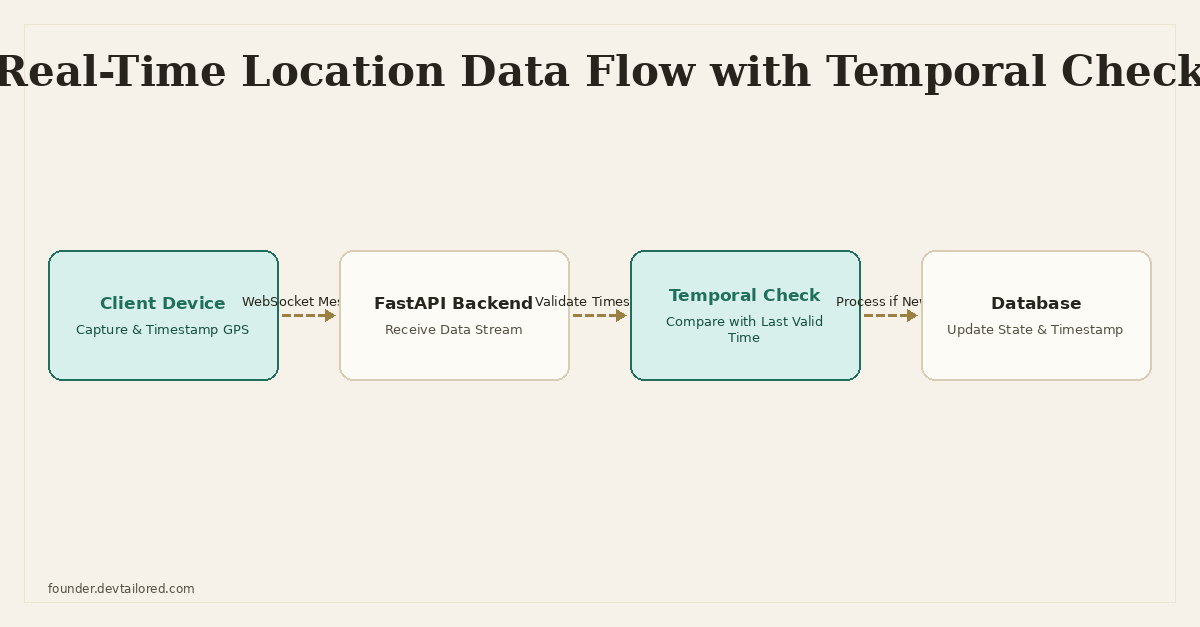
Ensuring Temporal Consistency: Handling Out-of-Order Real-Time Location Data
Building real-time systems is always an interesting challenge. You're constantly balancing performance, data integrity, and the inherent unpredictability of distributed environments. With the real-time attendance management system I built, which relies on GPS-verified student locations streamed over WebSockets, I ran into a subtle but critical issue: out-of-order data causing incorrect attendance records.
This wasn't a problem of raw WebSocket throughput or database contention, which I've tackled before. This was about the validity of the data itself, specifically its temporal relevance. It took a bit of digging, but the fix highlighted a fundamental principle of robust real-time system design.
The Problem: 'Teleporting' Students and Inconsistent Attendance
The attendance system uses a FastAPI backend with WebSockets to receive GPS coordinates from student devices. It then checks these coordinates against predefined geofences (e.g., classroom boundaries) to mark students as present or absent. For the most part, it worked well, handling hundreds of concurrent connections with low latency.
However, we started noticing strange discrepancies. A student might be correctly marked as 'Present' when they entered a classroom, only to inexplicably switch to 'Absent' a few seconds later, without physically moving. Then, just as suddenly, they'd revert to 'Present'. It looked like the system was suffering from intermittent 'teleportation' issues, which, as you can imagine, caused confusion and administrative headaches.
Here's a concrete example of the symptom:
- Student enters classroom. Device sends GPS
A(inside geofence) atT1. Server processesA, marks 'Present'. - Student is inside classroom. Device sends GPS
B(inside geofence) atT2. Server processesB, marks 'Present'. - Due to network conditions, an old GPS
C(outside geofence) that was captured atT0(beforeT1andT2) is finally delivered to the server. Server processesC, marks 'Absent'. - A new GPS
D(inside geofence) atT3arrives. Server processesD, marks 'Present'.
This sequence of events, where C (T0) arrived after B (T2), was the core of the problem. Our system was operating on a first-come, first-served basis for WebSocket messages. It assumed that the order of message arrival was the order of message truth. This assumption, common in simpler real-time designs, proved faulty in a real-world scenario with variable network latency.
The impact was significant: incorrect attendance records, manual corrections, and a lack of trust in the system's accuracy. It wasn't a performance bottleneck; it was a data integrity one.
Root Cause Analysis: The Illusion of Order
The investigation quickly pointed to network latency as the culprit. Mobile devices, especially in environments with patchy Wi-Fi or cellular coverage, don't always send data packets in the exact order they were generated. TCP generally ensures ordered delivery within a single connection, but when you have a stream of events, and those events might be slightly delayed or re-routed, their arrival order at the server might not perfectly match their generation order at the client.
Our initial WebSocket message processing loop looked something like this (simplified):
@app.websocket("/ws/location/{student_id}")
async def websocket_endpoint(websocket: WebSocket, student_id: int, db: AsyncSession = Depends(get_db)):
    await websocket.accept()
    try:
        while True:
            data = await websocket.receive_json()
            latitude = data.get('latitude')
            longitude = data.get('longitude')
            # Naive processing: immediately update attendance based on current lat/lon
            await process_location_update(db, student_id, latitude, longitude)
    except WebSocketDisconnect:
        print(f"Student {student_id} disconnected")
    finally:
        # Cleanup
        pass

async def process_location_update(db: AsyncSession, student_id: int, lat: float, lon: float):
    # Simulate geofence check and DB update
    is_present = check_geofence(lat, lon)
    await update_attendance_status(db, student_id, is_present)
    print(f"Student {student_id}: Lat {lat}, Lon {lon} -> Present: {is_present}")
The process_location_update function simply took the lat and lon it received and updated the student's status. There was no mechanism to check if this incoming coordinate was actually newer than the last one we successfully processed and recorded. If T0 data arrived after T2 data, T0 data would simply overwrite the state set by T2 data, leading to the 'teleportation' effect.
This highlights a common pitfall in real-time system design: assuming that the order of events received by the server directly reflects the chronological order of events generated by the client. In a truly distributed system, this assumption will eventually break down. We needed to introduce a concept of temporal consistency.
The Solution: Timestamping and Server-Side Validation
The fix involved two main components: client-side timestamping of every location update and robust server-side validation to ensure that only temporally newer data could update a student's status.
1. Client-Side Timestamping
First, I modified the client-side application (which was a web-based PWA, but the principle applies to native apps too) to include a high-resolution timestamp with every GPS coordinate it sent. Using Date.now() in JavaScript provides milliseconds since the Unix epoch, which is granular enough for this purpose.
Here's a conceptual snippet of the client-side logic:
// client.js (conceptual)

let ws = new WebSocket("ws://localhost:8000/ws/location/123");

ws.onopen = () => {
    console.log("WebSocket connected.");
    setInterval(() => {
        navigator.geolocation.getCurrentPosition(position => {
            const locationData = {
                latitude: position.coords.latitude,
                longitude: position.coords.longitude,
                timestamp: Date.now() // Crucial: Add a timestamp
            };
            if (ws.readyState === WebSocket.OPEN) {
                ws.send(JSON.stringify(locationData));
            }
        }, error => {
            console.error("Error getting location:", error);
        }, { enableHighAccuracy: true, timeout: 5000, maximumAge: 0 });
    }, 5000); // Send location every 5 seconds
};

ws.onmessage = event => {
    console.log("Server says:", event.data);
};

ws.onclose = () => {
    console.log("WebSocket disconnected.");
};

ws.onerror = error => {
    console.error("WebSocket error:", error);
};
This ensures that every message leaving the client carries its own temporal context. The timestamp is the critical piece of information that allows the server to make informed decisions about data relevance.
2. Server-Side Temporal Validation
On the FastAPI backend, I updated the database schema to include a last_processed_location_timestamp field for each student. This field would store the timestamp of the last successfully processed location update for that student. This is the server's authoritative view of the most recent valid event.
Here's the updated database model (using SQLAlchemy):
# models.py

from sqlalchemy import Column, Integer, String, Float, Boolean, BigInteger
from sqlalchemy.ext.declarative import declarative_base

Base = declarative_base()

class Student(Base):
    __tablename__ = "students"
    id = Column(Integer, primary_key=True, index=True)
    name = Column(String, index=True)
    current_latitude = Column(Float)
    current_longitude = Column(Float)
    is_present = Column(Boolean, default=False)
    last_processed_location_timestamp = Column(BigInteger, default=0) # New field

    def __repr__(self):
        return f"<Student(id={self.id}, name='{self.name}', is_present={self.is_present})>"
The BigInteger type for the timestamp is suitable for storing Unix milliseconds. It defaults to 0 to ensure any incoming timestamp will initially be newer.
Next, the process_location_update function was refactored to incorporate this temporal check:
# main.py (or a service file)

from datetime import datetime
from sqlalchemy.ext.asyncio import AsyncSession
from sqlalchemy.future import select
from app.models import Student # Assuming app.models is where Student is defined

# Placeholder for geofence check logic
def check_geofence(lat: float, lon: float) -> bool:
    # In a real system, this would involve comparing against polygon boundaries
    # For this example, let's say a specific lat/lon range means 'present'
    return 34.0 <= lat <= 35.0 and -118.0 <= lon <= -117.0

async def process_location_update(db: AsyncSession, student_id: int, lat: float, lon: float, client_timestamp: int):
    # Fetch the student record and their last processed timestamp
    result = await db.execute(select(Student).where(Student.id == student_id))
    student = result.scalars().first()

    if not student:
        print(f"Student {student_id} not found.")
        return

    # CRITICAL: Temporal consistency check
    if client_timestamp <= student.last_processed_location_timestamp:
        print(f"[Skipped] Student {student_id}: Incoming timestamp {client_timestamp} is not newer than last processed {student.last_processed_location_timestamp}.")
        return # Ignore older or duplicate messages

    # If the timestamp is newer, proceed with processing
    is_present = check_geofence(lat, lon)

    # Update student's location and attendance status
    student.current_latitude = lat
    student.current_longitude = lon
    student.is_present = is_present
    student.last_processed_location_timestamp = client_timestamp # Update the authoritative timestamp

    db.add(student)
    await db.commit()
    await db.refresh(student)

    print(f"[Processed] Student {student_id}: Lat {lat}, Lon {lon} (TS: {client_timestamp}) -> Present: {is_present}")


@app.websocket("/ws/location/{student_id}")
async def websocket_endpoint(websocket: WebSocket, student_id: int, db: AsyncSession = Depends(get_db)):
    await websocket.accept()
    try:
        while True:
            data = await websocket.receive_json()
            latitude = data.get('latitude')
            longitude = data.get('longitude')
            client_timestamp = data.get('timestamp')

            if not all([latitude, longitude, client_timestamp]):
                print(f"Invalid data received from {student_id}: {data}")
                continue

            await process_location_update(db, student_id, latitude, longitude, client_timestamp)

    except WebSocketDisconnect:
        print(f"Student {student_id} disconnected")
    except Exception as e:
        print(f"WebSocket error for student {student_id}: {e}")
    finally:
        # Ensure database session is closed
        await db.close()
The key change is the if client_timestamp <= student.last_processed_location_timestamp: check. This single line of code is what enforces temporal consistency. If an incoming message's timestamp is older than or equal to the last timestamp we successfully processed for that student, we simply ignore it. We only update the student's record and their last_processed_location_timestamp if the new data is strictly newer.
This approach effectively filters out stale, out-of-order messages, ensuring that the student's attendance status and recorded location always reflect the most recent information available. The 'teleportation' issues immediately vanished.
Considerations for Time Synchronization
One important aspect is time synchronization. Client device clocks can drift. For high-stakes applications, network time protocol (NTP) synchronization on clients is ideal. However, for most attendance systems, a few seconds of client-side clock drift is usually acceptable, as long as the relative ordering of events from a single client is maintained by its internal clock. The server's clock is assumed to be accurate and serves as the baseline for any server-side logging or event correlation across different students.
For this specific problem, where the issue was out-of-order events from a single client, trusting the client's internal Date.now() for relative ordering was sufficient. The absolute accuracy against a global clock was less critical than the internal consistency of a student's event stream.
Lessons Learned
This experience reinforced several critical lessons for building robust real-time systems:
- Don't Assume Order of Arrival == Order of Truth: Network latency and distributed client-server architectures mean that messages can, and will, arrive out of order. Always design with this in mind.
- Explicit Temporal Context is King: For any state-changing event in a real-time system, include a client-generated timestamp. This provides the necessary context for the server to determine the true chronological order of events.
- Server-Side Validation is Non-Negotiable: Relying solely on client-side data without server-side validation is a recipe for disaster. The server must be the ultimate arbiter of truth, especially when it comes to temporal consistency.
- Database as the Source of Truth (with Caveats): While the database is the persistence layer, for real-time temporal checks, it's crucial to store the last processed event's timestamp alongside the current state. This allows for quick, atomic checks directly within the processing logic.
- Simplicity in Filtering: The solution doesn't need complex buffering or re-ordering queues for this specific problem. A simple
if incoming_timestamp > last_known_timestampcheck is often enough to solve a significant class of data consistency issues.
This fix made the attendance system significantly more reliable and trustworthy. It's a reminder that sometimes the most challenging problems in distributed systems aren't about raw performance, but about ensuring the fundamental integrity and consistency of the data you're processing in real-time.
Frequently Asked Questions
What is temporal consistency in real-time systems?
Temporal consistency ensures that data processed reflects the most current state, especially when events might arrive out of their original chronological order due to network latency or client-side delays. It's about making sure older data doesn't overwrite newer, valid data.
Why do real-time location updates often arrive out of order?
Location updates, especially from mobile devices, are susceptible to network latency, varying signal strengths, and client-side processing delays. This can cause older GPS readings to be transmitted and arrive at the server after newer ones, leading to out-of-sequence events.
How can you prevent stale location data from causing incorrect state transitions?
The primary method is to include a reliable, high-resolution timestamp with every client-side location update. On the server, before processing any update, compare its timestamp against the last known valid timestamp for that entity. Only process the update if it's strictly newer.
What database changes are needed to support temporal consistency for location data?
You typically need to add a column to your user or attendance record table to store the `last_processed_location_timestamp`. This timestamp is updated only when a new, valid (newer-timestamped) location update is successfully processed, serving as the server's authoritative reference point.
Written by Ansh Gautam
Full-stack engineer building production systems with FastAPI, React, and AI/LLM integrations. Currently looking for backend engineering & AI integration roles.